Drake Fights Back as “Not Like Us” Lawsuit Explodes Again
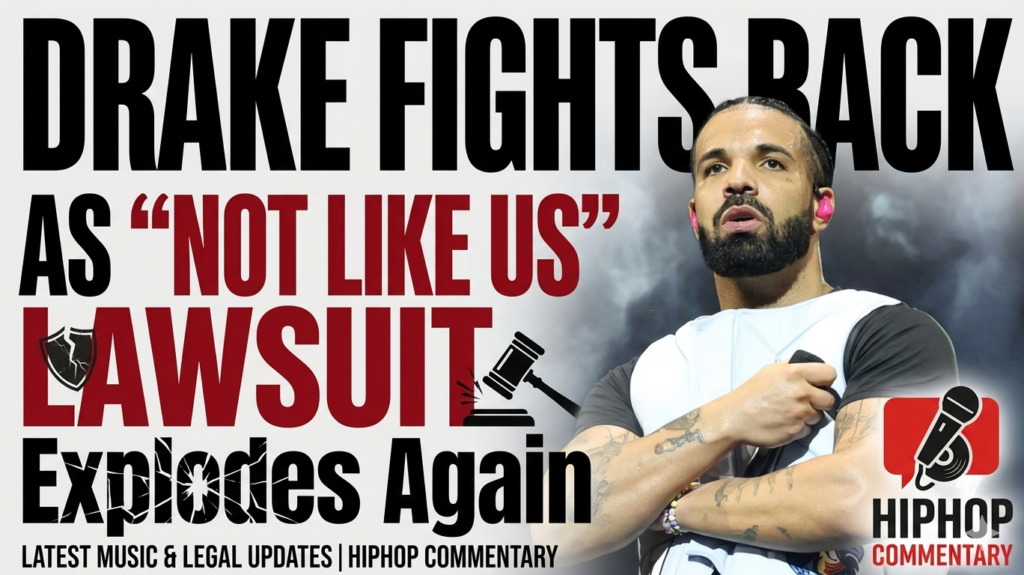
This rap war didn’t stay in the booth. It jumped straight into the courtroom, and now it’s getting deeper than anyone expected. Drake is back in the fight, and he’s not letting go of his claim that Kendrick Lamar’s “Not Like Us” crossed a serious line.
At first, a lot of people thought the story was done. A federal judge already tossed out Drake’s original lawsuit, and that usually means the door is closed. Case over. Move on. But Drake didn’t take it that way. He came right back with a stronger push, filing a new appeal against Universal Music Group, and this time, he’s coming with more detail and more pressure.
The heart of it hasn’t changed. Drake’s team still believes the track didn’t just stay in rap battle territory. They argue it went too far, turning into something that could damage his real-life reputation in a serious way. And in their words, this isn’t about ego or rap pride. It’s about defamation.
In the new court filing, his lawyers point straight at the lyrics in “Not Like Us.” They say the song includes accusations that paint Drake as a “criminal pedophile.” That’s a heavy claim, and his team is treating it as more than just rap talk or lyrical exaggeration. They’re saying it should be seen as a false statement that spread to millions of people.
But they don’t stop at the words alone. Drake’s legal team says the way the song was packaged and pushed made things worse. They point to the music video, the artwork, and how the track was promoted. Their argument is simple in a way: if you wrap a message in visuals and push it hard enough, people don’t just hear it as a diss, they start to believe it.
That’s where the case gets more complicated. Because diss tracks have always lived in that blurry space. Everyone knows rap battles are built on exaggeration, insults, and shock value. But Drake’s side is saying this one broke out of that bubble. It didn’t just land with hip hop fans who understand the game. It spread way beyond that.
And that reach matters a lot in this argument. Drake’s team says once a song goes mainstream at that level, the audience changes. It’s no longer just battle rap listeners breaking down punchlines. It’s casual listeners, radio audiences, social media users seeing clips with no context. And in that environment, they argue, people might take the message as fact.
Drake is also putting heat on Universal Music Group directly. His lawyers say the label didn’t just release the song, they actively pushed it. In their view, that promotion helped amplify the alleged message and made the damage worse. So now it’s not just artist versus artist. It’s artist versus one of the biggest music companies in the world.
Drake fights back in this appeal is also trying to challenge a bigger idea that came out of the first ruling. The judge previously dismissed the case by calling the lyrics “nonactionable opinion.” In simple terms, that means the court saw it as part of a rap feud, not a factual claim that could be legally proven or disproven.
But Drake’s side is pushing hard against that. They’re saying context alone shouldn’t be enough to protect everything said in a diss track. Their argument is that what matters is how the average person understands the message when they hear it, especially when it’s repeated online and stripped of its original context.
And they add another layer that hits directly at how the song spread. Drake’s team argues “Not Like Us” wasn’t just one of many tracks in the battle. It became the track. The one that went everywhere. The one people who weren’t even following the beef still heard.
That detail is key in their appeal. Because the earlier ruling leaned on the idea that listeners would recognize references and understand the back-and-forth nature of the feud. Drake’s lawyers say that assumption doesn’t hold up in real life. Most people didn’t go back and study the entire lyrical history. They just heard the viral song.
They even bring up Drake’s own response track, “Taylor Made Freestyle,” to make their point. According to the filing, that song had a much smaller reach and didn’t stay online long. So in their view, it’s unrealistic to assume the average listener caught all the layered references the court mentioned.
Now the case is sitting in a new phase, and the tension is rising again. Drake is essentially asking the court to take another look and reconsider how diss tracks are treated under the law. Not just in this case, but in general.
And that’s what makes this bigger than just one feud. Because if the appeal moves forward, it could set a new standard for how far rap battles can go before they cross into legal territory.
Right now, both sides are standing firm. The court isn’t done with it yet. And the music world is watching closely, because whatever happens next could reshape how hip hop handles its most aggressive tradition.
So the question hanging over all of this is bigger than Drake or Kendrick at this point.
When does a diss track stop being just rap… and start becoming something the law can’t ignore?