Meek Mill Fires Back After Charlamagne tha God Questions His Career… And He Didn’t Hold Back
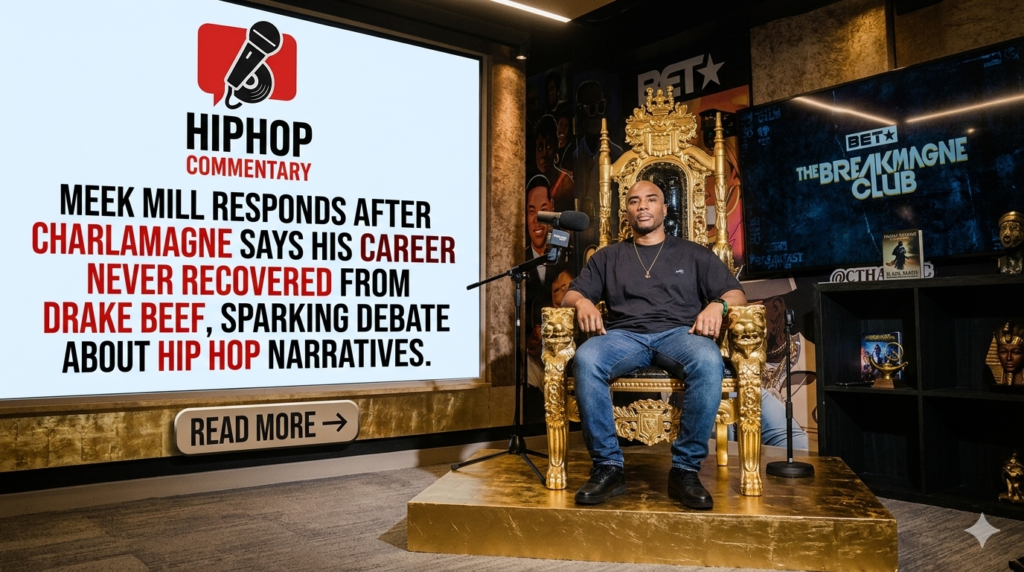
It started as a quick comment on a podcast, something most people would scroll past and forget in a few minutes. But hip hop don’t really work like that. One sentence can shake the whole timeline. And that’s exactly what happened when Charlamagne tha God said Meek Mill never fully recovered after his beef with Drake.
That line hit the internet like a spark in dry grass.
Clips started flying everywhere. Fans paused, rewound, argued in comment sections, all of it. Some people nodded like “yeah, that makes sense.” Others felt like nah, that’s a lazy take. Either way, the conversation was alive within minutes.
And Meek? He saw all of it.
Now, most artists would’ve ignored it, let the wave pass, move on like nothing happened. But Meek Mill didn’t do that. He jumped right into it. He reposted the clip himself, which already told you he wasn’t running from the discussion. He wanted in.
Then came the caption. That’s when things really started heating up.
Meek pushed back hard, like he had been holding that energy in for a while. He made it clear he’s not stuck in that Drake beef era. Yeah, it was loud. Yeah, it was everywhere. But to him, that’s just one chapter, not the whole book.
And you could feel the frustration behind it.
Because from Meek’s point of view, people keep freezing him in time. Like nothing after that moment matters. Like his whole career is just reduced to one viral feud from years ago. And he wasn’t letting that slide.
He started pointing out everything he’s done since then. The music, the success, the tours, the growth. The way he rebuilt his name step by step. In his eyes, that part of the story doesn’t get enough respect.
And that’s where things shifted from a simple clapback to something deeper.
Meek didn’t just defend himself. He started talking about how stories in hip hop get shaped in the first place. He used a strong word too, “propaganda.” That one word changed the whole tone of the conversation.
Now people weren’t just talking about Charlamagne’s comment anymore. They were asking bigger questions.
What did he mean by propaganda? Was he talking about media outlets pushing certain narratives? Was he talking about how the industry decides who gets remembered a certain way? Or was it more personal than that?
Nobody had a clean answer, but everybody had an opinion.
And that’s the thing about Meek’s situation. It’s never just about one moment. It’s about how that moment gets replayed over and over until it starts feeling like the whole story.
For Meek, that Drake beef is exactly that kind of moment.
Back when it happened, it was everywhere. Radio, social media, blogs, interviews, everything. It was one of those hip hop clashes that felt bigger than music for a while. Fans picked sides. Artists reacted. Even people outside hip hop knew about it.
But years later, that same moment still follows him around.
That’s what seems to bother him the most. Not that it happened, but that it keeps being the headline version of who he is. Like nothing else counts as much.
Still, not everybody agrees with Meek’s frustration.
Some fans say Charlamagne has a point. They feel like that beef did change how people saw Meek, especially in the public eye. Once something goes that viral, it doesn’t just disappear. It sticks. It becomes part of your image whether you like it or not.
Others push back on that idea completely.
They point to everything Meek has done since then. The albums, the activism, the business moves, the consistency. In their eyes, he didn’t get “stuck” at all. He kept going, and people just need to catch up.
That split is what keeps the conversation alive.
There’s no clean winner in this debate. No final answer. Just two sides looking at the same career from different angles. One side sees a defining setback. The other sees a comeback story that’s still unfolding.
And Meek, he clearly sees himself in the second group.
What made his response hit harder is that he didn’t dodge anything. He didn’t pretend the past didn’t happen. He acknowledged it, but he refused to be defined by it. That balance is what made the moment feel real instead of defensive.
Because underneath all the noise, this is really about legacy.
How do you want to be remembered in a culture that never forgets anything? One viral moment can live forever online, replayed over and over, shaping opinions long after the situation is over.
That’s the battle Meek is talking about without directly saying it.
And whether people agree with him or not, the reaction proves his point in a way. One comment turned into a full online debate, again. Years after the original beef, it’s still powerful enough to move the internet.
Right now, Meek Mill isn’t just reacting. He’s trying to take control of the narrative again, on his own terms. And hip hop fans are watching it unfold in real time, like they always do when a story refuses to die quietly.
Because in this game, the music is only part of it.
The story around the music, that’s what people keep coming back to.