The Iron Fist of 50 Cent: The Strict Rules That Built and Broke G-Unit
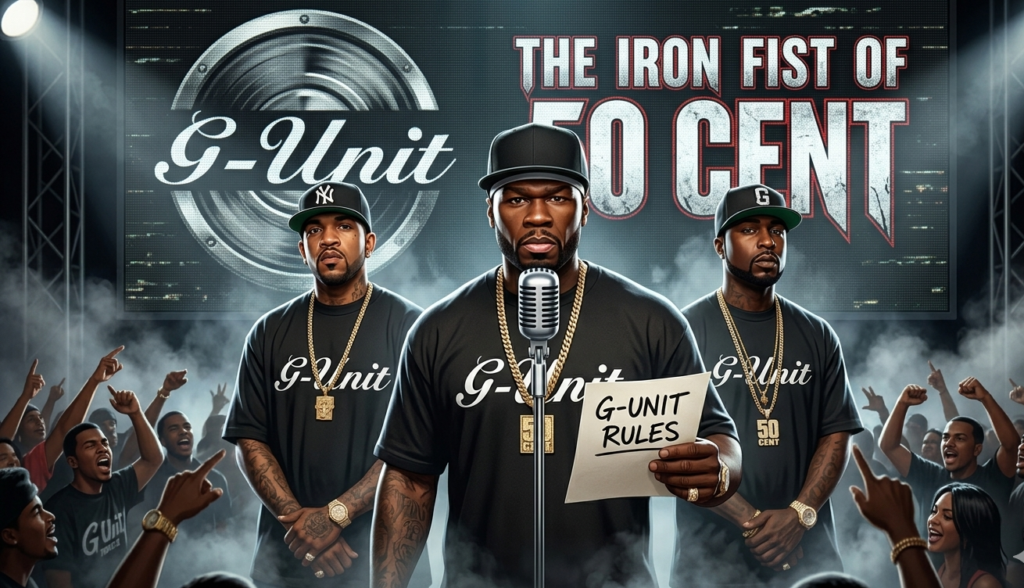
If you were really outside in the early 2000s, you don’t even need a memory jog. You felt G-Unit everywhere. It wasn’t just music, it was movement. You’d be on the train, walking through Queens, chilling in Brooklyn, and that red and black G-Unit logo was basically stamped into the culture like it owned the city.
And for a while, it kind of did.
50 Cent was at the center of it all. Not just as a rapper, but as a full-on architect. He wasn’t moving like a regular artist trying to get hot singles. He was building something bigger. A squad, a brand, a whole system that felt more like a street-run company than a rap group.
You had Lloyd Banks, the punchline machine with ice-cold delivery. Tony Yayo, the loyal day-one from Jamaica, Queens. Young Buck holding it down with that Southern grit. Later, The Game came in and brought that West Coast energy like gasoline on fire. Together, they weren’t just dropping tracks. They were moving like a unit that had a mission.
But behind all the jewelry, videos, and sold-out shows, there was a strict code holding everything together. And 50 Cent made sure everybody knew it.
See, 50 didn’t just want fame. He wanted control. He came up from real chaos in Southside Queens, survived getting shot, and turned pain into a global brand. So when he finally got power, he wasn’t about to let it slip through loose behavior or ego trips.
He ran G-Unit like a mix of CEO and street general. The rules weren’t complicated either. Be loyal. Stay in line. Don’t embarrass the squad. And whatever you do, don’t confuse success with being untouchable.
Sounds simple, right? Not really. Because when money hits and cameras follow you everywhere, people start acting like rules don’t apply anymore.
One of the clearest examples of how serious 50 was about discipline comes from Tony Yayo’s situation. Yayo wasn’t just another artist on the roster. That was his brother from Queens, someone who had been there before the fame, before the deals, before the world cared.
So when something went down at 50’s home in Connecticut and Yayo ended up in a heated situation with someone, it turned into more than just a personal issue. In a normal street setting, your people might jump in and ride with you. That’s how loyalty usually works on the block.
But 50 wasn’t thinking like the block that day. He was thinking like the boss of a brand worth millions.
He shut it down fast. No arguing, no long debate. His rule was clear. No violence in his house. Not even from his closest people. Because in his mind, if he bent that rule once, everything he built could start slipping.
That decision hit different. Yayo explained himself, but 50 wasn’t trying to hear emotion over structure. The message was simple and cold. If you can’t follow the rules, you can’t stay in the system.
And just like that, he even went as far as saying Yayo could be moved off the G-Unit setup, sent to another label under the Interscope umbrella. In industry terms, that’s not just a warning. That’s like getting pulled out of the starting lineup of a championship team.
It showed everybody something important. In 50’s world, being day-one didn’t put you above the code.
But if Yayo’s story was a warning shot, what happened with The Game was a full explosion.
When The Game first joined G-Unit, it looked like a perfect match. East Coast dominance meets West Coast hunger. His album The Documentary came out the gate strong, with Dr. Dre and 50 Cent behind him. It felt like G-Unit had unlocked another level.
For a moment, everything clicked.
But fame changes energy fast. The Game started moving differently. Interviews started sounding a little more independent. Then came the real problem, the G-Unit rule about loyalty in beef.
50 was already in war mode with Fat Joe and Jadakiss. In his system, if the boss has a problem, the whole squad is supposed to stand together. No side conversations. No neutral zones.
But The Game started saying he didn’t have issues with those guys. He tried to separate himself from the beef while still being in the crew.
That didn’t sit right with 50.
To him, that wasn’t neutrality. That was disloyalty. Because G-Unit wasn’t built on individual lanes. It was built on moving as one force.
Things escalated quickly. Radio interviews, call-ins, subtle shots, pressure building on all sides. Then 50 made a move that shocked the whole industry. He went on Hot 97, live on air, and announced The Game was out of G-Unit.
No private meeting. No behind-the-scenes cleanup. Just a public cutoff.
And the wild part? The Game was actually at the station when it happened. That moment instantly became one of those hip hop scenes people still talk about years later. It didn’t just end a partnership. It sparked one of the most heated beefs in rap history.
After that, everything split. Records, interviews, crews, even fans. You were either on G-Unit’s side or The Game’s side. There wasn’t much middle ground.
Looking back, that strict control 50 enforced was both his greatest strength and his biggest problem.
On one hand, it built something unstoppable for a time. G-Unit moved like a machine. They dominated charts, mixtapes, radio, everything. Nobody could really match their momentum. It felt like they had figured out how to turn street energy into a corporate empire.
But the same structure that made them powerful also made it hard for people inside it to breathe.
Artists like Lloyd Banks and Young Buck had talent that deserved space. The Game had his own wave. Even Yayo, loyal as they come, was still an artist with his own voice. But under a system that demanded full alignment at all times, cracks were almost guaranteed to show.
Eventually, those cracks turned into separation.
That’s why people still talk about G-Unit like a legend and a lesson at the same time. They showed what happens when discipline meets ambition at the highest level in rap. They also showed what happens when control gets too tight for too long.
Was 50 Cent a genius for building it that way? Yeah, no doubt. Was he also a control-heavy leader who pushed people out when they stopped moving exactly how he wanted? That part is true too.
Both things can exist at the same time.
And that’s why G-Unit still matters in hip hop history. Not just for the music, but for the story behind it. The rise, the rules, the loyalty, and the fallout.
Because in this game, building an empire is one thing. Keeping everyone inside it moving in sync without breaking it apart? That’s a whole different battle.