The Hidden Similarities Between Eminem and King Von
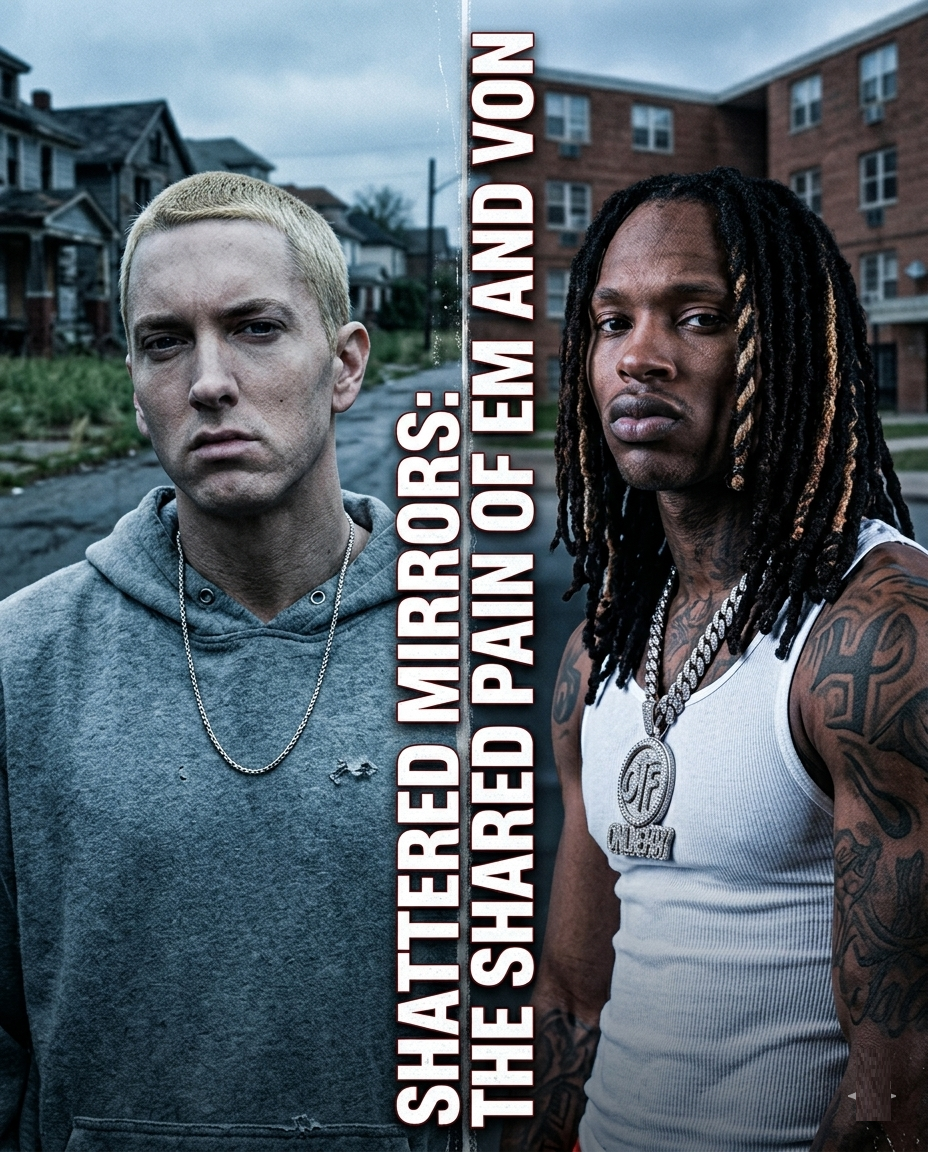
If you were tapped into hip hop in 2020, you remember that moment clear as day. Kid Cudi and Eminem linking up for “The Adventures of Moon Man & Slim Shady” already felt like something out of left field. Two different worlds colliding on one track. Then Eminem drops a line that made everybody pause their phones, rewind, and listen again.
“R.I.P. to King Von.”
Just like that.
No setup. No long explanation. Just a straight shoutout in the middle of a verse from one of the biggest rappers to ever touch a mic. And for a second, the whole internet stopped scrolling.
A lot of people were confused at first. Eminem is a Detroit legend. King Von was a rising voice out of Chicago drill, someone still early in his run before his life was cut short in 2020. On paper, they didn’t look like they belonged in the same conversation. Different eras, different cities, different lanes in hip hop.
But if you look deeper than the labels, it starts to make sense real quick.
Both of them came from places where life doesn’t give you soft landings. No safety nets. No gentle introductions to the world. Just pressure, struggle, and survival from the jump.
Eminem grew up in Detroit, moving from place to place, never really staying stable. Always the new kid. Always the target. You hear it in his early music, that frustration, that feeling of being boxed out and underestimated. Every bar he wrote carried a chip on his shoulder. He wasn’t just trying to rap. He was trying to prove he even deserved to be in the room.
That kind of upbringing sticks to you. It sharpens you, but it also hardens you.
Now look at King Von. Chicago’s South Side, O Block specifically, is a different kind of environment. Not just tough, but constant pressure. Von didn’t just rap about the streets, he was shaped by them. His stories weren’t fictional creations. They were lived experiences turned into music.
And that’s what made him stand out so fast. He wasn’t just riding a wave. He was painting scenes.
Both artists, even though they sounded different, were carrying the same kind of emotional weight. That deep, heavy feeling of losing people too soon. Of growing up too fast. Of learning lessons you never asked for.
For Eminem, a lot of that pain came from his relationship with his parents, especially his mother and the absence of his father. He talked about it constantly in his early work. That sense of abandonment shaped his anger, his humor, and even his technical style. Everything was sharpened by that early chaos.
For Von, the trauma hit in a more violent way. His father was killed when Von was still a kid, just 11 years old. Imagine trying to understand life after something like that. That kind of loss doesn’t just disappear. It stays with you, changes how you move, how you trust, how you see the world.
And then came the moment that changed Von’s life forever. His close friend White White was killed right in front of him when Von was just 17. That’s not something you process and move on from. That’s something that rewires you completely. People close to him said that after that day, something shifted in him. A different kind of energy came out in his music after that. He wasn’t just telling stories anymore. He was reliving them.
Eminem had his own version of that breaking point years later when his best friend Proof was killed in 2006. Proof wasn’t just a friend. He was family. A protector. A creative partner. The guy who helped shape the Detroit scene alongside him. Losing Proof hit Em hard. Real hard. You could hear it in the music that followed. The tone changed. The humor got darker. The pain sat closer to the surface.
Different cities. Different circumstances. Same kind of emotional damage.
That’s part of why Eminem’s shoutout to King Von felt deeper than just a passing tribute. It felt personal in a way people didn’t fully catch at first.
Von wasn’t just another rapper in the drill wave. He was a storyteller. When you listen to tracks like “Crazy Story,” it doesn’t feel like he’s rapping, it feels like he’s narrating a scene you can actually see. You hear the tension. You picture the corners. You feel the paranoia. It’s detailed, almost cinematic.
That’s something Eminem understands better than most. Early Slim Shady records weren’t just songs either. They were full characters, full scenes, full narratives. He used storytelling to deal with trauma, confusion, anger, everything. He built entire worlds inside verses.
So when Em hears someone like Von, it’s not just another rapper to him. It’s someone using the same tool for the same reason, just in a different environment.
That connection matters in hip hop more than people realize. Because under all the styles, trends, and regional differences, the core of it is still truth. Real emotion. Real experience. Real pain translated into rhythm.
That’s why Eminem’s shoutout hit differently. It wasn’t industry politics. It wasn’t clout chasing. It felt like recognition from one storyteller to another. From someone who knows what it means to carry heavy memories and still turn them into art.
And that’s the part a lot of fans connected with once they thought about it. Hip hop changes all the time. Sounds evolve. Drill, trap, boom bap, melodic rap, all of it comes and goes in waves. But the feeling behind it stays the same.
Pain doesn’t change language. It just finds a new voice.
Eminem has been that voice for Detroit pain for decades. King Von became that voice for Chicago’s streets in a short but powerful run. Both of them turned lived experience into something the world couldn’t ignore.
So when Em said “R.I.P. to King Von,” it wasn’t random. It was recognition. Respect. A nod from one survivor of the pen to another.
And that’s why that moment still sticks with people. Not because it was loud, but because it was real. In a culture full of noise, sometimes the quietest lines carry the most weight.
Real recognizes real. Even across generations, even across cities, even across different chapters of the game.