The $400 Million Rule: How One Line About Hailie Jade Ended a Dynasty
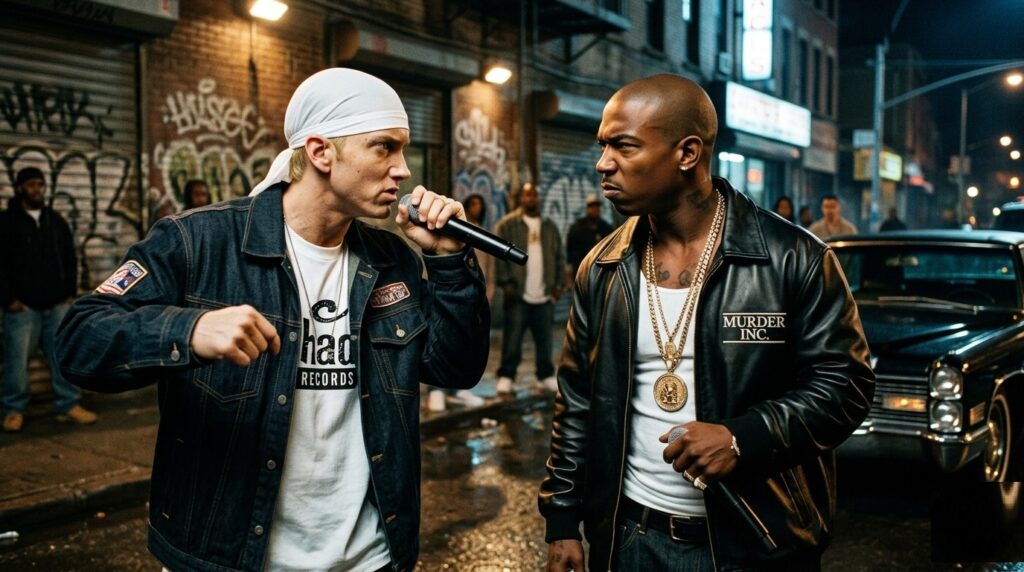
Back in the early 2000s, hip hop didn’t feel safe. That’s the best way to explain it. Every week somebody was beefing, somebody was getting dissed, somebody was outside looking for revenge. The energy was raw back then. Real raw. You could turn on the radio in New York and hear chart-topping records during the day, then hear full-blown lyrical warfare on mixtapes by nighttime.
And right in the middle of all that chaos stood three names that changed rap history forever: Eminem, 50 Cent, and Ja Rule.
People talk about rap beef all the time now, but younger fans gotta understand something. This wasn’t just social media trolling or a few shady tweets. This was career-ending warfare. The kind that changed radio stations, labels, friendships, and whole bank accounts.
And somehow, a huge part of it exploded because one rapper decided to mention another man’s daughter.
That’s the part people still can’t believe.
See, before all the destruction happened, Ja Rule was actually winning. A lotta people forget that now because history rewrote the story a little, but back then Ja was huge. We’re talking massive radio records, sold-out shows, chart dominance. The man had hits everywhere. Clubs, parties, car radios, MTV, BET you couldn’t escape him.
Meanwhile, Eminem was already becoming a global superstar himself. The wild white boy from Detroit who rapped like his life depended on it. Every verse sounded dangerous. Every song felt unpredictable. Parents hated him, kids loved him, and the music industry couldn’t stop talking about him.
At first, their worlds didn’t really clash directly.
The real tension started because of 50 Cent.
Back then, 50 was still the hungry street dude from Queens trying to take over New York. And he had serious smoke with Ja Rule and the whole Murder Inc. camp long before Eminem fully stepped into the situation.
Depending on who you ask, the problems started over robbery accusations, disrespect in clubs, or street politics in Queens. Either way, things escalated quickly. This wasn’t friendly competition anymore. People were getting jumped, threatened, stabbed. The energy around the feud felt genuinely dangerous.
Then came the game-changing moment.
Dr. Dre and Eminem signed 50 Cent to Shady/Aftermath.
That move changed everything overnight.
Now 50 wasn’t fighting alone anymore. He suddenly had two of the biggest forces in music standing behind him. And Ja Rule saw it exactly for what it was — war.
That’s when lines got drawn.
Ja basically made it clear that if Eminem and Dre were siding with 50, then they were enemies too. Simple as that. No middle ground. No peace talks.
At first, Eminem mostly stayed cool about it publicly. He threw little shots here and there, but nothing too nuclear. Honestly, it seemed like he was letting 50 handle most of the direct fighting while he focused on albums and touring.
But then Ja Rule made one giant mistake.
The kind you can’t really come back from.
In 2003, Ja dropped a diss track called “Loose Change.” And instead of just attacking Eminem’s music or image, he brought up Em’s daughter, Hailie Jade.
The line instantly crossed a boundary.
Even people who weren’t huge Eminem fans knew that mentioning somebody’s child like that was risky territory. Hip hop has always been disrespectful, sure. Rappers clown each other all the time. But kids? Most people understood that was supposed to stay off limits.
Ja ignored that completely.
And the second he did, the whole tone of the beef changed.
You could almost feel Eminem’s anger through the speakers after that.
The response came fast too.
Em linked with D12 and Obie Trice for the brutal diss track “Doe Rae Me,” better known by fans as “Hailie’s Revenge.” And from the jump, the song felt cold. Calculated. Personal.
It wasn’t just regular battle rap anymore.
It sounded like somebody trying to destroy another rapper mentally.
Eminem mocked Ja Rule’s voice, his image, his credibility, everything. He accused Ja of copying Tupac Shakur and pretending to be tougher than he really was. Every verse sounded meaner than the last.
And the scary part?
The Shady/Aftermath/G-Unit machine never stopped pressing the attack after that.
They kept dropping diss tracks. Kept clowning Murder Inc. in interviews. Kept humiliating Ja publicly every chance they got. 50 Cent especially turned it into a full-time mission. It felt like every mixtape had another shot aimed at Ja Rule.
At the same time, real-world problems started piling onto Murder Inc. too.
Federal investigations started circling the label over alleged ties to drug kingpin Kenneth McGriff. Suddenly the label wasn’t just fighting rappers anymore. The feds were involved too.
That pressure changed everything.
The music started slowing down. Radio stations shifted focus. Fans moved toward 50 Cent’s movement instead. And once Get Rich or Die Tryin’ exploded, it honestly felt like Ja Rule’s momentum disappeared overnight.
That album hit like a wrecking ball.
Everywhere you went, people were playing 50. In cars. In barbershops. In clubs. New York fully embraced him. Meanwhile Ja Rule started becoming the punchline of rap jokes instead of the king of radio.
That’s what made the whole thing so brutal historically.
This wasn’t just losing a rap battle.
It felt like losing an entire empire.
People still debate today whether Ja Rule really deserved all the blame for Murder Inc.’s downfall. Some say the federal investigation hurt the label more than the beef itself. Others believe 50 and Eminem simply outworked and out-rapped them publicly until fans turned away.
Truth is, it was probably both at the same time.
But one thing nobody debates?
Mentioning Hailie made Eminem go nuclear.
And Marshall never really let it go either.
Years later, he still references Ja Rule in songs sometimes. You can tell certain names stay locked in his memory forever. Eminem’s the type of artist who treats disrespect like unfinished business. Once you enter that mental list, good luck getting off it.
As for Ja Rule, he’s spent years defending himself and reflecting on that era. Sometimes he sounds proud that it took such a massive group effort to take him down. Other times you can hear frustration underneath it all. Because no matter how people spin history now, Ja Rule really was on top once.
That’s what makes the story kinda tragic honestly.
One wrong decision. One disrespectful line. One emotional moment in a diss track. And suddenly everything changes forever.
Hip hop history is full of lessons like that.
Sometimes the smartest move in a beef ain’t the harshest line. Sometimes it’s knowing where to stop before things spiral too far. Ja Rule learned that lesson the hard way. By bringing Eminem’s daughter into the fight, he gave one of the deadliest lyricists alive a personal reason to destroy him.
And once Eminem took it personally?
There was no coming back from that smoke.