The Shady Protection: Why You Never Mention Hailie Jade
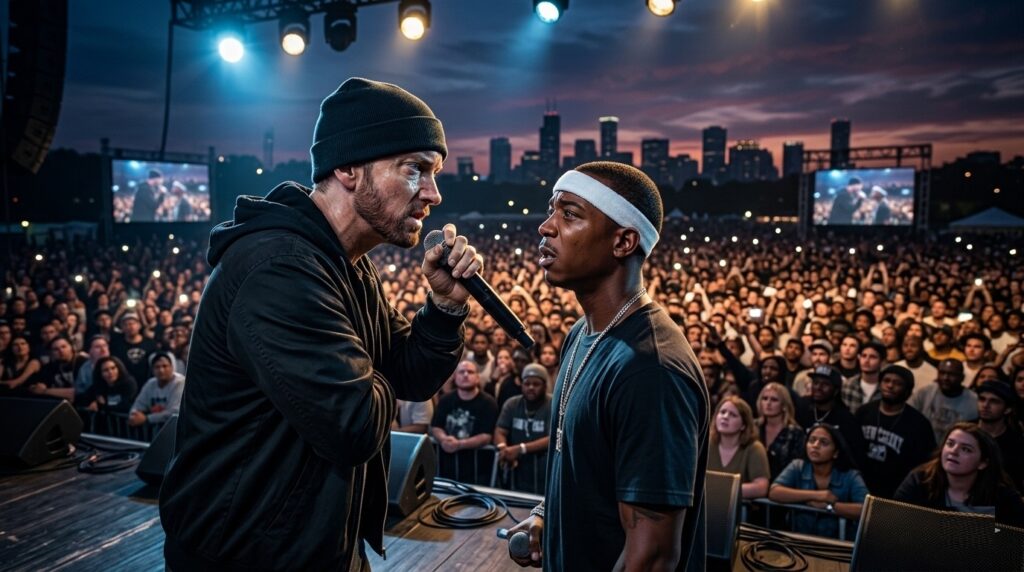
If you’ve been around hip hop long enough, you already know there are just some lines you don’t cross. It ain’t written on paper, but everybody in the culture feels it. You don’t go at Nas like he’s some random rookie. You don’t step in front of Jay-Z like it’s a small-time hustle. And when it comes to Eminem, there’s one rule everybody learned the hard way keep his daughter out your mouth.
Simple as that.
And still, a few people tried it anyway.
Hip hop beef is usually entertainment. It’s part sport, part marketing, part ego battle. Two rappers throw shots, fans pick sides, blogs go crazy, and everybody eats off the drama. But with Eminem, it never felt like a game. Dude raps like he’s protecting something deeper. Slim Shady is the loud one, the wild one, the one saying whatever he wants. But Marshall? That’s a father first. And at the center of that whole world is Hailie Jade.
So when people crossed that line, they weren’t just starting beef. They were stepping into a situation they didn’t fully understand.
Over the years, three names really stand out in that story: Ja Rule, Benzino, and Machine Gun Kelly. And each one found out the same lesson in a different way some lines don’t come back from.
Let’s start with Ja Rule.
Back in the early 2000s, Ja Rule was everywhere. Radio hits, hooks, features, he had the game on lock. Murder Inc. was running the charts like a machine. At first, he wasn’t even really focused on Eminem. The real smoke was with 50 Cent.
But when 50 Cent signed with Eminem’s camp under Shady/Aftermath, things got personal real quick. Now Em was tied into the beef whether he wanted it or not.
Still, he stayed in the background at first. Let 50 do the talking. But Ja Rule made a move that changed everything.
On a track called “Loose Change,” he started throwing shots that weren’t just industry talk anymore. He went at Em’s family. His mom. His ex-wife Kim. And then he slid in a line about Hailie.
That was it.
You can almost picture the moment. Quiet studio. Beat still playing. Eminem hearing that line and just going cold. Not angry in a loud way. More like focused. Locked in. The kind of silence that means something big is coming.
And it did.
Eminem didn’t respond with just one diss. He coordinated like it was war time. D12 jumped in, 50 Cent came through, even Busta Rhymes got involved on the “Hail Mary” remix. It wasn’t just music anymore—it was pressure from every angle.
Ja Rule got hit from all sides, and his image never recovered the same way. One minute he was at the top of the game, next minute he was stuck trying to survive a storm he helped create. That was the first real lesson: you don’t bring family into it unless you’re ready for everything that comes back.
Then came Benzino.
Now this one hit different because it wasn’t just rap vs rap. It was rap vs media power.
Benzino wasn’t just an artist he was tied to The Source magazine, one of the most respected voices in hip hop back then. So when he started calling Eminem a “culture vulture,” it wasn’t just bars. It was influence, ratings, and industry pressure.
He used The Source like a weapon. Holding back ratings. Criticizing Em constantly. Trying to paint him as an outsider who didn’t belong in the culture.
But then he crossed another line and started bringing Em’s personal life into it.
That’s when Eminem snapped back with tracks like “The Sauce” and “Nail in the Coffin.” And if you’ve heard those records, you know it wasn’t playful. It was surgical. Every verse felt like it was cutting something apart piece by piece.
He exposed Benzino’s credibility, his career, and his motives all in one run. No yelling needed. Just precision.
The fallout was brutal. Benzino lost respect in the industry, lost influence at The Source, and his rap career basically faded out. Even now, years later, he still talks about that beef like it’s yesterday. That’s how heavy it hit.
But the most famous chapter of this whole story came later, with a new generation watching.
Enter Machine Gun Kelly.
Back in 2012, a young Machine Gun Kelly sent out a tweet about Hailie that rubbed a lot of people the wrong way. She was underage at the time, and he called her attractive. Most people thought it would just fade away like internet noise.
Not with Eminem.
He didn’t react immediately. That’s the part people always forget. He waited. Years passed. MGK built his name, got bigger, stayed active in the game.
Then 2018 hit.
Eminem dropped Kamikaze, and suddenly the past wasn’t the past anymore. On “Not Alike,” he brought up that old tweet directly. Calm, sharp, no wasted energy. Just a reminder: I didn’t forget.
MGK responded fast with “Rap Devil.” And for a minute, people thought maybe this was different. Maybe Eminem finally met someone who could stand toe to toe with him in the modern era.
That idea didn’t last long.
Because then came “Killshot.”
And when that dropped, the whole conversation shifted in real time. Eminem went line for line, bar for bar, and picked apart everything his image, his style, even the little things people usually ignore. It wasn’t just a diss track. It felt like a full shutdown.
After that, something interesting happened. MGK pivoted out of rap and leaned heavily into pop-punk. He found success there, no doubt. But in hip hop, the verdict was basically settled. Once you step into that ring with Eminem and the bell rings like that, it leaves a mark.
So when you zoom out on all three situations, a pattern shows up real clear.
You can joke with Eminem. You can criticize him. You can even compete with him musically. But once you bring his daughter into it, everything changes.
It stops being about rap.
It becomes personal survival.
And that’s why the “Hailie rule” stuck around for so long in hip hop. Not because people fear him, but because they watched what happened to the ones who didn’t respect that line.
Ja Rule learned it. Benzino learned it. MGK felt it in real time.
Different eras, different outcomes, same lesson.
In this game, there’s competition… and then there’s boundaries. And with Eminem, that boundary is one of the clearest in hip hop history.