Eminem vs Lord Jamar: The “Guest in Hip-Hop” Debate That Shook the Culture
Hip-hop stays loud, but sometimes the real noise ain’t the beats. It’s the arguments. The kind that split fans, friends, even legends. And one debate still won’t die.
Is Eminem a true hip-hop legend… or just a guest standing in someone else’s house?
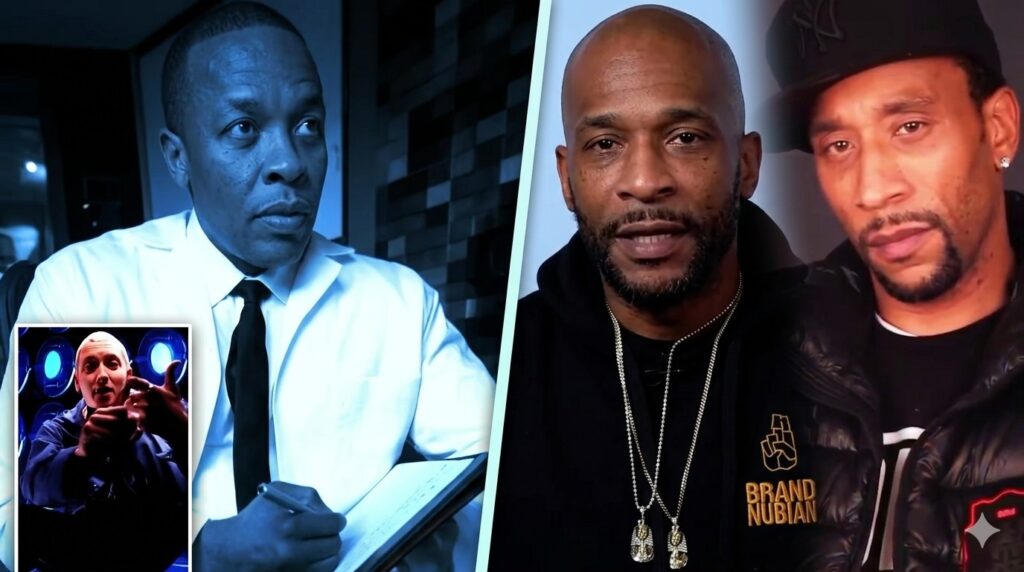
That question didn’t come from nowhere. It grew from years of tension between Eminem, the Detroit rap machine who turned pain into punchlines, and Lord Jamar from Brand Nubian, a voice that’s always been protective of hip-hop’s roots. Once this conversation started, it spread like wildfire.
Back in 2013, things really kicked off during an interview on VladTV. Lord Jamar didn’t sugarcoat anything. He said hip-hop is Black culture, born from struggle, streets, and survival. In his eyes, white rappers like Eminem could be in the house, but they don’t own it. They’re guests.
That word “guest” stuck like glue.
Jamar wasn’t trying to start drama at first. He said it was about respect. He compared it to history, how Black art forms have been taken over before, watered down, or repackaged for profit. He even brought up Elvis Presley as an example of how culture can shift hands in ways that feel unfair.
His message was simple but sharp. Don’t forget where this comes from.
Then he took it a step further. He said Eminem is skilled, no question. The bars, the speed, the wordplay, all of it. But in his view, Eminem didn’t come from the same lived experience as the streets that built hip-hop. And because of that, Jamar argued his “Greatest of All Time” talk mostly comes from white fans and industry push, not the core culture.
That hit a nerve across hip-hop.
For years after that, Eminem stayed mostly quiet. No interviews breaking it down. No long responses. Just music. But silence in hip-hop never really means peace. It usually means pressure building up.
Then 2018 hit like a storm.
Eminem dropped Kamikaze out of nowhere. No warning, no rollout. Just straight energy and frustration. And on the track “Fall,” he finally addressed Lord Jamar directly. No more silence.
He didn’t just respond, he pushed back hard. The message was clear. He wasn’t going to sit there and be labeled like that without saying something. Fans who had been watching the debate explode online finally got what they were waiting for, a response from Em himself.
But that wasn’t the end.
In 2020, Eminem doubled down on the track “I Will.” This time, the shots were even sharper. He questioned Jamar’s place in hip-hop history and made it personal, even calling him out as the weakest link in his own group.
At that point, it stopped looking like a debate. It looked like a full rap war.
Social media went crazy. Fans picked sides. Comment sections turned into battlegrounds. One half defended Eminem as one of the greatest lyricists to ever touch a mic. The other side echoed Jamar, saying culture and roots still matter more than skill alone.
Then something nobody expected happened.
During an interview with KXNG Crooked, Eminem shifted the tone completely. No anger. No punches. Just honesty.
He admitted something that shocked a lot of people. He said he sees himself as a guest in hip-hop.
That moment changed the energy instantly.
Instead of fighting the idea, Eminem leaned into it. He explained that he always understood where hip-hop comes from. He never claimed ownership over it. He called himself a student of the culture, someone who studied the greats like Rakim, Kool G Rap, and Masta Ace. Artists who shaped the foundation he grew up on.
That admission hit different. For some fans, it showed humility. For others, it felt like confirmation that Lord Jamar had been right all along, at least in part.
The hip-hop world split even more.
On one side, artists like 50 Cent and Royce Da 5’9” stood firmly with Eminem. 50 Cent made it clear that while hip-hop is Black music at its core, Eminem’s impact can’t be denied. Royce backed his longtime friend and collaborator, pointing to decades of respect earned in the booth, not just hype.
On the other side, voices like Conway the Machine added a more grounded take. He acknowledged Eminem’s greatness but said something real. A lot of Em’s music doesn’t reflect what’s playing in today’s streets. And for some fans, that matters when talking about relevance in the culture.
So the conversation stopped being simple. It wasn’t just “who’s better.” It became something deeper. Identity. Ownership. Respect. And who gets to define hip-hop in the first place.
Over time, the tension cooled off. Royce Da 5’9” helped ease things between the sides. Lord Jamar later said he had no personal hate for Eminem, even if he never changed his opinion about the “guest” idea.
But the damage, or maybe the impact, already lived on.
Because this wasn’t just another rap beef. There were no diss tracks back and forth forever. No ending victory lap. It forced hip-hop fans to sit with uncomfortable questions. Does skill override culture? Can someone master a space they didn’t come from? And who gets to decide what “real” even means?
Eminem never tried to erase hip-hop’s roots. Lord Jamar never tried to deny Eminem’s talent. But both stood on different sides of the same truth.
Hip-hop is more than music. It’s history, pain, expression, and identity all mixed together. And when someone steps into it from the outside, no matter how good they are, the debate will always follow them.
So even now, years later, the question still hangs in the air.
Is being a guest enough if you’re one of the greatest to ever do it? Or does greatness still have to answer to the house it came from?
Hip-hop still hasn’t agreed on the answer.