Suge Knight vs Eminem Rap History and the Death Row Aftermath Rivalry
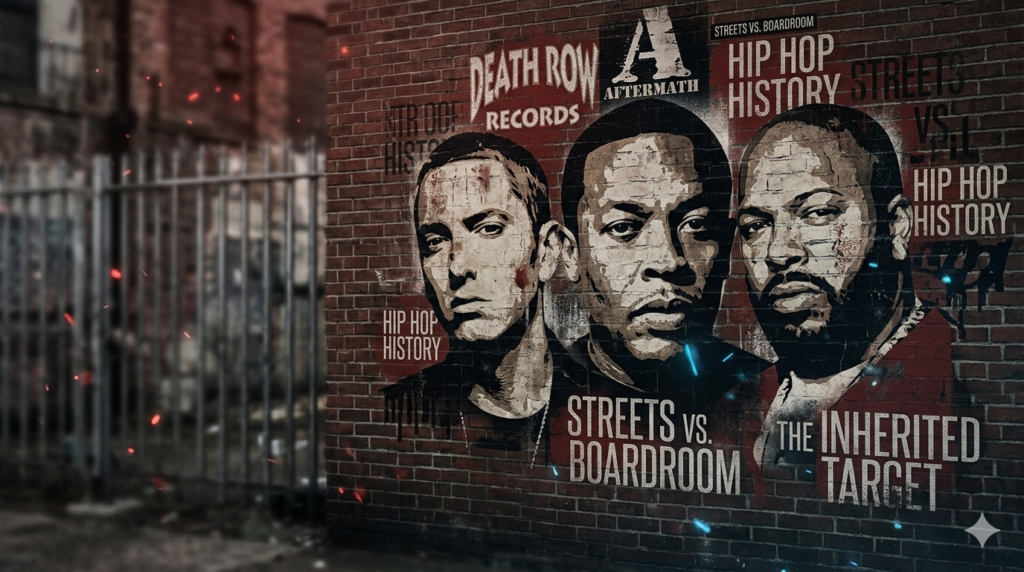
If you really want to understand how rough the rap game used to get, you can’t just look at the music videos or the award shows. That’s the polished side. The real story sits in the shadows, where business turns personal real quick and music starts feeling like a battlefield.
Back in the late 90s, hip hop wasn’t just about who had the best hook or the hottest beat. It was survival mixed with pride, ego, and street politics all tangled together. And at the center of that storm was Death Row Records, a label that felt less like a company and more like a kingdom built on pressure.
Death Row wasn’t small-time anything. It was a monster in the industry. Dr. Dre, Snoop Dogg, Tupac Shakur, the sound of the West Coast at its peak. But behind all that success, things were breaking apart. The shine was fading and the cracks were getting louder every year.
Two names stood at the heart of it all. Dr. Dre on one side, Suge Knight on the other.
Dre was the creative mind. Calm, focused, the type of guy who cared about the music more than the noise around it. He wanted structure, clean business, no chaos in the hallway, no constant tension in the office.
Suge Knight was the opposite. Big presence, heavy energy, and a way of running things that felt more like the streets than the boardroom. Everything was pressure, control, and loyalty. If you were in, you were all in. If not, you were out.
At first, that mix worked. It created hits. It built Death Row into a powerhouse. But over time, the same energy that made it successful started tearing it apart.
By the mid-90s, Dre had enough. The environment wasn’t healthy anymore. Too many fights, too much paranoia, too many problems behind the scenes. So he made a move that would change hip hop forever. He left Death Row and started Aftermath Entertainment.
Now in the music world, leaving a label is one thing. Leaving a situation like Death Row? That was different. That wasn’t just business. That felt personal.
Suge Knight didn’t take it lightly. Not even close.
To him, Dre walking away wasn’t just a departure. It was betrayal. They built the empire together, and now Dre was stepping out with industry lawyer Jimmy Iovine, trying to rebuild something new from scratch.
And that’s where Eminem enters the picture.
At the time, Eminem was just a skinny kid from Detroit trying to find his place in a game that wasn’t exactly welcoming him with open arms. Dre saw something in him that nobody else did. Raw talent, sharp writing, and a voice that cut through everything.
So Dre signed him. That decision didn’t just launch Eminem’s career. It also pulled him straight into a war he didn’t start and probably didn’t even fully understand at first.
Because in Suge Knight’s eyes, Eminem wasn’t just another rapper. He was a symbol. Dre’s new weapon. The face of Aftermath.
And Suge wasn’t the type to ignore things like that.
The tension between them didn’t stay quiet for long. One of the most talked-about moments came during the 2001 Source Awards. Back then, that event wasn’t just an awards show. It was a pressure cooker. Every label, every crew, every artist in the building felt like something could pop off at any moment.
Eminem showed up with his bodyguard, Byron “Big Naz” Williams. But because of the setup, the bodyguards couldn’t sit right next to the artists. That left Eminem sitting alone in the crowd.
That’s when things got tense.
According to people who were there, a group linked to Death Row started circling him. Red shirts everywhere. The energy shifted fast. Shouting, threats, close distance. The kind of moment where everybody in the room starts paying attention even if they don’t want to.
Big Naz later described it like Eminem was suddenly surrounded in enemy territory. Security had to step in and remove him from his seat before things went too far. He still performed that night, but the message was clear. Even on a stage full of celebrities, the old Death Row energy still had reach.
And it didn’t stop there.
Fast forward to 2002. Dr. Dre is now working with 50 Cent, and they’re filming the “In Da Club” music video. It was supposed to be a celebration. A fresh start. New era energy.
Then Suge Knight shows up.
Not alone either. He came with a group, rolling into the set like he still owned the temperature of the room. Nobody needed an announcement to understand what was happening. The mood changed instantly.
People on set described it like a standoff waiting to happen. Tension in the air, security tightening up, helicopters overhead. Suge later said he was just checking things out, but nobody believed that version. It felt like a reminder. Like he was saying, “Don’t forget who used to run this.”
Even with all that, Eminem kept moving forward. But it wasn’t easy. Early in his career, he couldn’t just show up and relax. There were times he wore bulletproof vests to public events. Security wasn’t optional. It was part of life.
That pressure shows up in his music too. Songs like “Like Toy Soldiers” reflect the weight of watching conflict build around him while trying not to add fuel to it. He had loyalty to Dre, respect for his crew in D12, and a growing awareness that reacting emotionally could make things worse.
So he stayed focused on the music.
That’s what made the difference.
While Suge Knight tried to apply pressure through presence and reputation, Eminem stayed in the studio, building records that pushed him further away from the chaos. Instead of breaking under the tension, he leveled up. His albums sold millions. His name went global. The more pressure came in, the more he turned it into fuel.
What’s wild is how simple the real conflict actually was underneath everything. It wasn’t just about diss tracks or appearances at events. It was about power shifting in hip hop. The old system built on fear and control was starting to lose its grip, and a new wave built on music, branding, and global reach was taking over.
Eminem just happened to be standing in the middle of that transition.
Today, the story feels like something from another lifetime. Suge Knight is behind bars, his empire long gone. Eminem is a Hall of Fame artist with a legacy that still shapes rap culture. Dre is one of the most successful producers and businessmen the industry has ever seen.
Looking back, it wasn’t just a beef. It was a turning point. A moment where hip hop shifted from one era into another.
And Eminem, whether he planned it or not, survived the storm and came out on the other side as one of the last men standing.