The Shadow of the Stunna: The Real Story of Birdman
Yo, real talk, when you talk about heavy hitters in hip hop business, Birdman is one of those names that always gets people split right down the middle.
Some folks look at him like a straight-up genius. The type of dude who turned nothing into a whole empire. Others look at him like a cold street boss who just knew how to play the game better than everybody else. Either way you slice it, you can’t ignore him. Not even close.
Because without Birdman, the rap game of the 2000s and beyond would look completely different.
Before the jewelry, the private jets, and all that loud luxury lifestyle energy, Birdman was just Bryan Williams coming up out the Third Ward in New Orleans. And that environment? It wasn’t soft at all. Real struggle, real survival, real pressure from a young age.
He lost his mother when he was only five. That alone would shake anybody. After that, life bounced him around a bit until he ended up under his father’s care, who was out here hustling with bars and laundromats just to keep things moving. That’s where Birdman really started learning the early lessons of money, survival, and control.
And one thing about him he picked up on the hustle game fast. Like, really fast.
By the time he was a teenager, stories were already floating around the city about how he was moving differently. Not schoolyard talk either. We talking street reputation, grown-man conversations. The kind of energy that made people either respect you or stay far away.
That’s also where the “Baby” persona started forming, which later turned into the Birdman we all know today.
Fast forward to 1991, and Birdman links up with his brother Ronald “Slim” Williams to start Cash Money Records. Now at the time, most labels were begging big companies for deals just to survive. Cash Money wasn’t doing that.
They flipped the script.
Instead of being controlled, they wanted ownership. And that mindset changed everything.
By 1998, they locked in a massive distribution deal with Universal worth tens of millions. But here’s the part people still talk about Cash Money kept ownership of their masters. That move right there was the foundation of everything that came after. It wasn’t just about getting rich quick. It was about controlling the whole pipeline.
And then came the biggest piece of the puzzle.
A young kid from New Orleans named Lil Wayne.
Birdman signed him when he was just a child. Twelve years old. Back then, Wayne wasn’t even “Lil Wayne” yet. He was just a talented kid with bars and hunger, running around the studio soaking up game like a sponge.
Birdman didn’t just sign him like a regular artist. He took him in. Guided him. Put structure around his life at a time when he really needed it.
After Wayne’s stepfather, Rabbit, passed away, that bond got even deeper. It stopped being just business. It turned into something that looked a lot like family. Almost like father and son in a world where most relationships don’t last five minutes.
And for a long time, that bond looked unbreakable.
Then came 2006.
A photo hit the internet Birdman and Lil Wayne sharing a kiss on the lips. And the hip hop world lost its mind. Back then, the culture was way more rigid about masculinity and image, so people ran with it instantly.
Memes, jokes, criticism everywhere.
But Birdman didn’t fold. He doubled down. He said Wayne was like his son, his firstborn, and that was just how he showed love and respect. No shame, no backing up.
To him, it wasn’t weird. It was loyalty.
But loyalty in the music business? That word gets tested fast.
By the mid-2010s, things between Birdman and Wayne started cracking hard. Money got involved. Contracts got involved. Feelings got involved.
By 2014, it turned into a full legal war over tens of millions of dollars. Wayne wanted out. He wanted his album, Tha Carter V, released. He felt like things were being blocked and promises weren’t being kept.
That’s when the story shifted from “family empire” to “business war.”
And when money and ego collide in hip hop, it never stays quiet.
Rumors started flying. Legal threats. Public statements. Even darker whispers in the background about tension that went way beyond music. The internet started drawing comparisons to other legendary industry conflicts, saying it had that same cold energy you see when power starts breaking apart.
By that point, Cash Money wasn’t just a label anymore. It was a battlefield.
And it wasn’t just Wayne either.
Artists like Juvenile and B.G. also spoke out over the years, saying they didn’t always feel properly handled when it came to money and contracts. The narrative started shifting in the media. Birdman wasn’t just a boss anymore he was being painted as someone who played hardball with the people closest to him.
Then came one of the most viral moments in hip hop media history.
April 22, 2016.
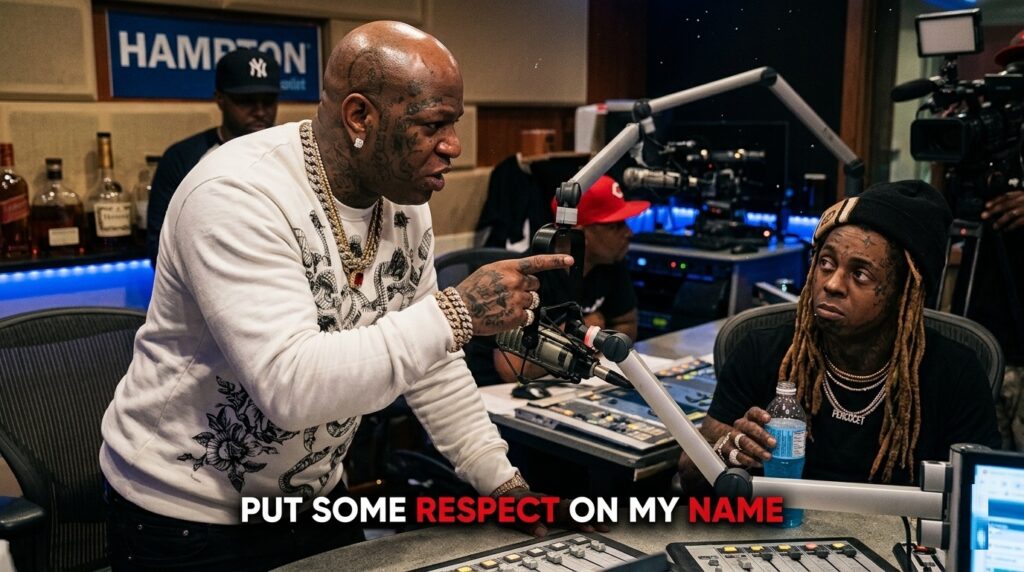
Birdman walks into The Breakfast Club with his whole crew behind him, all dressed in white. The energy in that room was tense before he even sat down.
And it didn’t take long for things to explode.
He demanded respect. Straight up. No jokes, no sideways questions, no slick commentary about his name.
When Charlamagne Tha God pressed him, Birdman shut it down quick. He basically told him, “I’m pulling up on you,” and just walked out the studio like the whole conversation was over.
That moment went viral instantly.
“Put some respect on my name” became more than just a clip. It turned into a phrase people still quote today in music, memes, and everyday conversation. Whether people laughed at it or respected it, everybody remembered it.
Now, when you compare Birdman to someone like Suge Knight, the similarities and differences get interesting.
Both came from street environments. Both ran their labels with serious authority. Both built rosters that shaped entire eras of hip hop. But their legacies split in different directions.
Suge’s Death Row Records burned fast. Big impact, short lifespan. Cash Money? That machine adapted. It survived. It evolved. It brought in new generations.
Because while Birdman started with Wayne, the next wave included artists like Drake and Nicki Minaj—and that changed everything. Cash Money didn’t just stay relevant. It stayed dominant for decades.
That’s rare. Like really rare in music.
Today, Birdman moves different. Still rich. Still flashy. Still low-key mysterious in how he carries himself. Gold watches, quiet smirk, that signature hand rub it’s all still there.
And people still debate him.
Was he a ruthless businessman who pushed loyalty too far? Or was he just a smart operator who turned a rough upbringing into a global empire?
Truth is, it depends on who you ask.
But one thing nobody can really argue with Birdman built something that changed hip hop forever. Love him or hate him, the blueprint he helped create is still shaping the game today.
And in this industry, that kind of impact don’t fade easy.