You don’t just disrespect Muhammad Ali… not while Mike Tyson is still breathing.
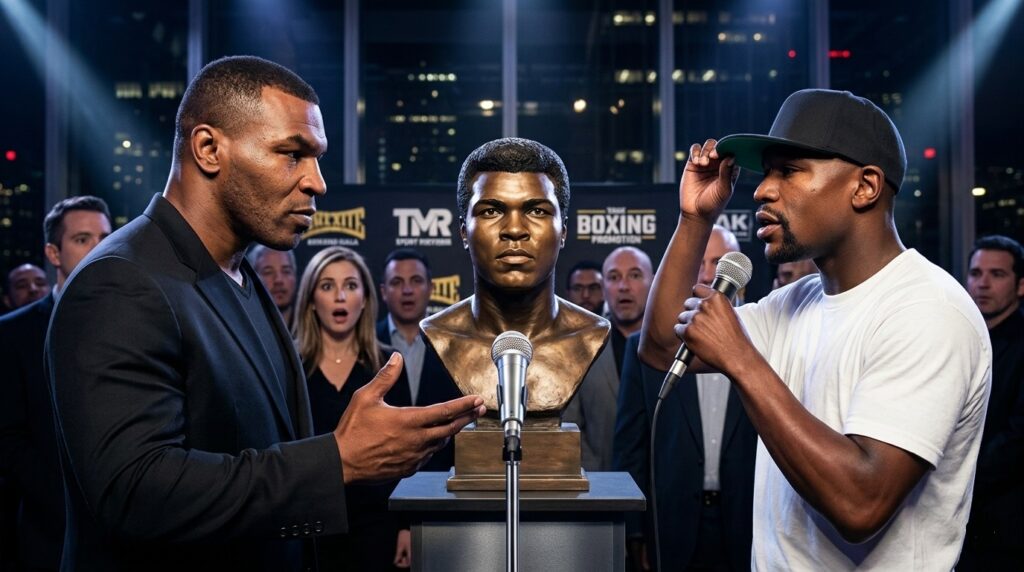
For Mike Tyson, this whole Floyd Mayweather debate isn’t really about boxing stats or shiny records. It runs deeper than that. Way deeper. It’s personal, like something carved into his memory that never left.
It goes back to Muhammad Ali.
And for Tyson, Ali isn’t just a boxing legend. He’s the reason Tyson even believed he could become anything in life.
So when Floyd Mayweather started calling himself the greatest of all time, it sounded like normal boxing talk to a lot of people. Fighters do that all the time. They compare records, wins, losses, all that. But Tyson heard it different. To him, it felt like someone stepping over a line you just don’t cross.
That tension really started heating up around 2015. Floyd was heavy on his undefeated record, 50-0, perfect career, no losses. He pushed that like it was proof of everything. His message was simple. If you never lost, you must be the best that ever did it.
But Tyson wasn’t buying that logic at all.
He pushed back in a way only Tyson can. No long speech. Just straight honesty. He called Floyd delusional. And he said something that stuck with people. To Tyson, greatness isn’t about staying safe or avoiding damage. It’s about how the world feels about you when you’re done fighting.
That right there shifted the whole conversation.
Tyson wasn’t even really attacking Floyd’s skills. He respects Floyd as a fighter. Nobody doubts that. What Tyson was really talking about was what Floyd represents. A fighter who mastered control, distance, protection, and staying untouched.
To Tyson, that’s not the same as what Ali stood for.
Because Ali didn’t move like that. Ali walked straight into chaos. He stood in front of power, politics, criticism, and still kept going. Even when it cost him everything, he didn’t fold.
That’s where Tyson’s loyalty kicks in.
But this story doesn’t start in adulthood. It goes all the way back to when Tyson was just a kid trying to survive.
He was 13 years old when he ended up in a reform school. Not a promising path at all. By that time, he had already been arrested more than 30 times. Most people around him probably thought his life was already decided.
But then something happened that changed his direction completely.
Muhammad Ali walked into that reform school.
Not for fame. Not for a show. No big spotlight moment. He came to talk to kids who were lost, angry, and written off. Kids like Tyson.
And when Tyson saw him in person, something clicked. Imagine that for a second. A kid from the streets, already caught up in the system, suddenly seeing a man who looked like a king, standing right there in front of him. A man who fought the government, spoke his truth, and still became the most famous fighter in the world.
That moment stayed with Tyson. It didn’t fade.
For the first time, he started thinking maybe his life didn’t have to end where it was headed.
Years passed, and Tyson climbed into the boxing world himself. Fast hands, scary power, and a presence that made people nervous before he even threw a punch. He became a champion. But Ali still stayed in his mind like a guiding figure.
Then came another moment that hit Tyson hard.
Ali lost to Larry Holmes.
For most fans, it was just another fight in boxing history. But for Tyson, it felt personal. He watched it and didn’t take it well at all. He cried that night. That’s how deep it went for him.
The next morning, his trainer Cus D’Amato arranged something powerful. He got Muhammad Ali on the phone with Tyson. Just imagine that call. A young Tyson speaking directly to the man he looked up to his whole life.
During that time, Tyson made a promise. He told Ali he would avenge him one day.
And years later, he did exactly that.
When Tyson knocked out Larry Holmes, he didn’t celebrate like it was just another win. After the fight, Ali was there in the ring. Tyson walked up to him, leaned in close, and said, “I got him for you.”
That moment became bigger than boxing. It became memory, legacy, respect.
So when Floyd Mayweather enters the conversation, Tyson isn’t just comparing fighters. He’s comparing philosophies. Two completely different ideas of what greatness means.
Floyd Mayweather represents perfection on paper. Undefeated. Defensive genius. Smart career moves. Massive earnings. A fighter who built a system where he almost never took real damage.
But Tyson looks at Ali and sees something else entirely.
Ali fought the best when they were at their peak. He took punishment. He lost fights. He stepped away from boxing for years because of his beliefs and still came back. He risked money, fame, and comfort for what he believed was right.
That kind of sacrifice sticks with Tyson more than any record ever could.
And that’s why this debate never really settles in boxing circles or anywhere else. Floyd has the numbers. That’s undeniable. But Ali has the story, the culture, the impact, the weight of history behind him.
In spaces like hip hop and street culture, that matters a lot. It’s not just about wins and losses. It’s about what you stood for when everything was on the line.
Tyson falls on that side every time.
Even now, years later, he still speaks about Ali with a kind of respect that feels deeper than admiration. More like loyalty. Like protection. Like a promise that was never broken.
Because to Tyson, Ali isn’t just the greatest boxer who ever lived.
He’s untouchable