Eminem Benzino feud history The Source magazine destruction
Back in the early 2000s, if you were really tapped into hip-hop, you already knew one thing for sure. If The Source magazine liked you, you were up. If they didn’t, your whole career could feel like it was on thin ice. That magazine wasn’t just paper and ink. People called it the “Bible of Hip-Hop” for a reason. It shaped opinions, broke careers, and basically decided who was “real” and who wasn’t.
Now running that whole machine was Raymond “Benzino” Scott. On paper, he had power most artists could only dream about. He was part owner of the most important hip-hop magazine in the world. But Benzino didn’t just want power behind the scenes. He wanted the spotlight too. He wanted respect as a rapper, not just a boss.
That’s where things started falling apart.
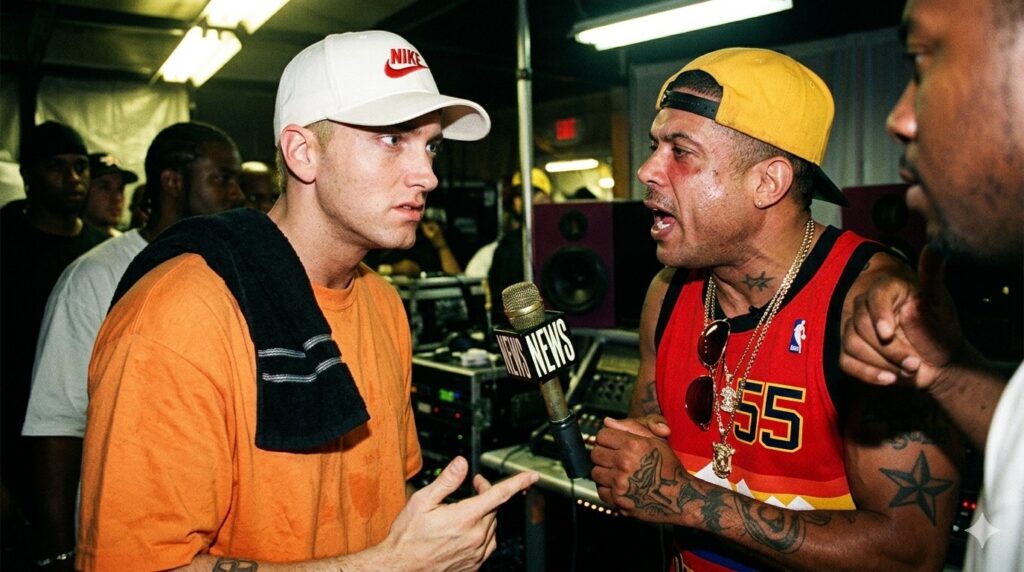
Because right around that same time, a kid from Detroit named Marshall Mathers, better known as Eminem, was taking over the entire game. And when those two worlds collided, it didn’t stay a normal industry disagreement. It turned into one of the longest, nastiest beefs in hip-hop history. A real war that ended up shaking an entire media empire.
It all started around 2002. Benzino was juggling two identities. By day, he was helping run The Source. By night, he was trying to push his rap career with groups like Made Men and The Almighty RSO. And that’s where the problem was obvious to everybody except him. His music wasn’t hitting like that. But somehow, his magazine covers kept finding their way to his own projects.
People in the game started whispering. Then talking louder. Then straight up calling it favoritism. It felt like he was using the biggest platform in hip-hop as his personal promo tool.
Then Eminem dropped The Eminem Show in 2002. That album was everywhere. Stadium energy. Global attention. The kind of project that defines an era. So when The Source gave it four mics instead of five, fans felt it instantly. Four mics is still supposed to mean great, but in this case, it felt like a slap in the face. Like somebody was holding the gate shut on purpose.
Eminem noticed too. And he didn’t just brush it off.
At the same time, Benzino was publicly calling Eminem a “culture vulture” and dragging his name through interviews. He even compared him to Vanilla Ice, trying to strip away his credibility. That’s when the situation stopped being industry talk and turned into full-blown personal war.
Eminem did what he always does when he feels attacked. He went straight to the booth.
Late 2002 into 2003, he unloaded diss tracks like “The Sauce” and “Nail in the Coffin.” And he didn’t hold back at all. He wasn’t just going at Benzino as a rapper. He was attacking the whole structure of The Source, calling out what he saw as corruption and bias.
What made it hit even harder was how specific he got. He went after Benzino’s age, his career struggles, and the idea that he was forcing himself into a lane that didn’t really welcome him as an artist. One of the most talked-about lines was when Eminem brought up Benzino trying to push his own son into music, saying it looked like he was chasing fame through his family after missing his own shot.
That line stuck with people because it wasn’t just disrespect. It felt personal in a different way. Like Eminem was saying, “you’re not even building your own legacy, you’re trying to borrow one.”
But Benzino wasn’t done yet. He tried to swing back with something bigger.
In 2003, he pulled out old footage of Eminem from his teenage years, including controversial recordings from before fame. The goal was clear. Destroy Eminem’s image. End his run. He pushed the idea that Eminem was a “threat” to hip-hop culture and tried to rally the industry against him.
For a moment, it looked like things might shift.
But it didn’t land the way he expected.
Eminem owned it in his own way. He didn’t deny being reckless as a young kid. Instead, he addressed it head-on in songs like “Yellow Brick Road,” explaining where he was mentally at that time and acknowledging he was wrong. That honesty changed the direction of the conversation.
A lot of the hip-hop community didn’t turn on him like Benzino hoped. Instead, they started looking at Benzino’s move as desperation. Like he was using old pain to win a modern fight.
And then the industry itself started reacting.
Major labels pulled advertising from The Source. The magazine that once had untouchable influence started losing credibility fast. What was supposed to be the “Bible of Hip-Hop” was now being talked about like just another biased outlet with personal agendas behind the curtain.
By 2006, Benzino was officially removed from the magazine’s leadership. But by then, the damage was already done. The Source never really got its old power back again.
Eminem, on the other hand, kept rising.
Fast forward to 2026, and the fallout from that beef is still visible in different ways. Benzino ended up in reality TV spaces like Love & Hip Hop: Atlanta, staying in the public eye but not really in the rap conversation anymore. His daughter, Coi Leray, would later break out as a successful artist herself, building her own lane in the industry. But even that story came with public tension and family drama that people couldn’t help but connect back to Benzino’s past battles over fame and control.
Then in 2024, the old energy flared up again when Eminem took another shot at him on “Doomsday Pt. 2.” It wasn’t a full restart of the war, but it reminded everybody that the history between them never fully cooled off. Some beefs just leave scars, even decades later.
Looking back, this whole Eminem and Benzino saga is bigger than personal dislike. It’s about power in hip-hop. Who controls the narrative. Who gets respected. And what matters more, influence behind a desk or skill on a mic.
The story left one lesson hanging over the culture. You can own the magazine, the platform, the spotlight, all of it. But if the pen can’t outwrite the mic, the mic will always win in the end.
And in hip-hop, that truth never really changes.