The Night Bad Bunny Took Over the Super Bowl… And Started a War
You could feel people getting uncomfortable before the performance even ended.
That’s how you knew Bad Bunny really did something.
Most Super Bowl halftime shows follow the same formula. Big lights. Safe songs. A little nostalgia. Maybe a surprise guest pops out and everybody tweets for ten minutes before moving on with their life. The NFL usually plays it careful because the audience is huge. Families watching. Older folks watching. Casual fans who barely even listen to music watching.
So when Bad Bunny stepped onto that stage and started performing almost fully in Spanish, without softening it down for anybody, the whole vibe changed fast.
Some people loved it instantly.
Other people? Man, they got tight.
And honestly, that reaction told the whole story better than the performance itself.
Bad Bunny didn’t walk into the Super Bowl trying to make everybody comfortable. He walked in like somebody who already knew exactly who he was. No fake crossover act. No “let me throw in extra English lines so middle America feels safe.” Nah. He performed the way he wanted to perform, in the language that built his career and made millions of people connect with him in the first place.
That takes guts on a stage that massive.
We talking about over 135 million viewers watching around the world. That’s not just another concert. That’s one of the biggest stages on Earth. Legends touched that stage. Michael Jackson. Prince. Beyoncé. Dr. Dre. Rihanna. Everybody knows the pressure that comes with that moment.
And somehow Bad Bunny still made it feel personal.
The wild part is, people online started debating whether the performance was “too Spanish” almost immediately. You had social media exploding with arguments. Some folks said the Super Bowl should feel “American.” Others claimed they couldn’t connect because they didn’t understand the lyrics.
That’s where the whole conversation got real weird though.
Because Bad Bunny is American.
Puerto Rico is part of the United States. Puerto Ricans have been American citizens for over a hundred years. But every time a Puerto Rican artist gets huge on a global level, the same identity conversation pops back up. Like people suddenly forget basic facts the second Spanish enters the room.
That backlash exposed something bigger underneath all the football and entertainment talk.
It showed how some people still only see “American” one way.
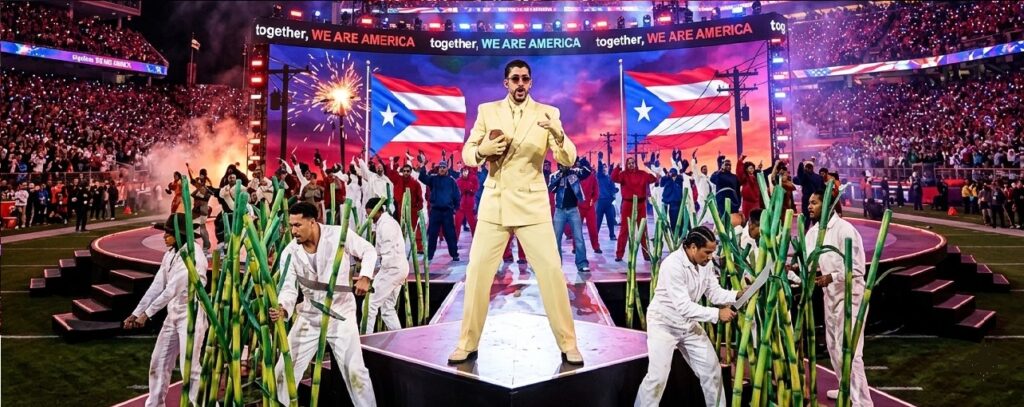
Bad Bunny challenged that without even arguing. He didn’t stop the show to give speeches every five minutes. He let the visuals speak. And if you were really paying attention, there was a lot being said up there.
The sugar cane fields in the performance weren’t random decoration. That imagery carries deep history in Puerto Rico and throughout the Caribbean. Labor. Exploitation. Colonial history. Generations of struggle people don’t always learn about in school. Then you had the power poles and blackout imagery pointing toward Puerto Rico’s energy crisis and all the problems the island has dealt with for years.
A lot of people watching probably missed those details because they were too busy arguing online about language.
But Bad Bunny knew exactly what he was doing.
Then came the flag.
Not the regular Puerto Rican flag most people recognize either. The light blue version. That one carries political meaning tied to independence movements and resistance. Once that flashed across the screen, social media really started losing its mind.
Some viewers saw entertainment.
Others saw protest.
Truth is, it was both.
That’s why the performance hit so hard.
Hip hop and Latin music always been connected to real life. Pain. Pride. Identity. Survival. You can dance to the records while still understanding there’s deeper meaning underneath. That’s what great performers do. They give you energy while saying something real at the same time.
And Bad Bunny been moving like that for years already.
People forget this dude didn’t come into the industry trying to fit old industry rules. He came in sounding different, dressing different, talking different. Early on, there were still folks acting like Latin artists had limits. Like they could maybe have a crossover hit here and there but never fully dominate global music culture.
Now look around.
Bad Bunny sells out stadiums worldwide. His albums break streaming records. Crowds scream every lyric whether they speak Spanish fluently or not. That right there changed the game.
Music don’t work the same way anymore.
Back in the day, English was treated like the “required” language for global pop success. Bad Bunny basically kicked that whole idea in the face. He proved people care more about feeling something than perfectly understanding every word.
That’s real music.
You ever been in a New York club where a song comes on and everybody loses their mind even though half the room doesn’t fully know the lyrics? That energy is universal. Rhythm hits first. Emotion hits first. Culture hits first.
Bad Bunny understands that better than most artists alive right now.
And honestly, the criticism probably made the performance even bigger.
That always happens when somebody shakes people up. The more folks complained, the more others defended him. Puerto Ricans especially came out heavy online showing pride. Latin fans everywhere felt seen. A lot of people said it was the first time they watched a halftime show and felt fully represented instead of treated like an extra side audience.
That matters.
Especially because major American stages haven’t always embraced Latin culture properly. For years Latin artists had to “cross over” by changing themselves. Softer accents. More English lyrics. Less culture. More industry polish.
Bad Bunny basically said nah to all of that.
He stayed himself completely and still became one of the biggest stars on Earth.
That’s why the line “Together, we are America” hit people so hard too.
Simple sentence. But it carried weight.
Because “America” means more than one image, one culture, one language, or one background. It’s layered. Messy. Loud. Different. The whole hemisphere carries pieces of that identity. Bad Bunny brought that idea to the biggest sports stage in the country and forced people to sit with it whether they liked it or not.
And let’s be honest for a second. If the performance was weak, nobody would still be talking about it.
The reason it became such a giant debate is because it landed. It stuck in people’s heads. Some got inspired. Some got angry. Some felt represented for the first time. Others felt challenged. That’s what real cultural moments do.
They don’t leave everybody comfortable.
Years from now, people probably won’t remember every touchdown from that Super Bowl. But they’ll remember Bad Bunny standing in front of millions of viewers, refusing to water himself down for anybody.
That’s the part people can’t stop talking about.
READ NEXT: Mama Tina’s Famous Gumbo Spot Back Open After Quick Shutdown