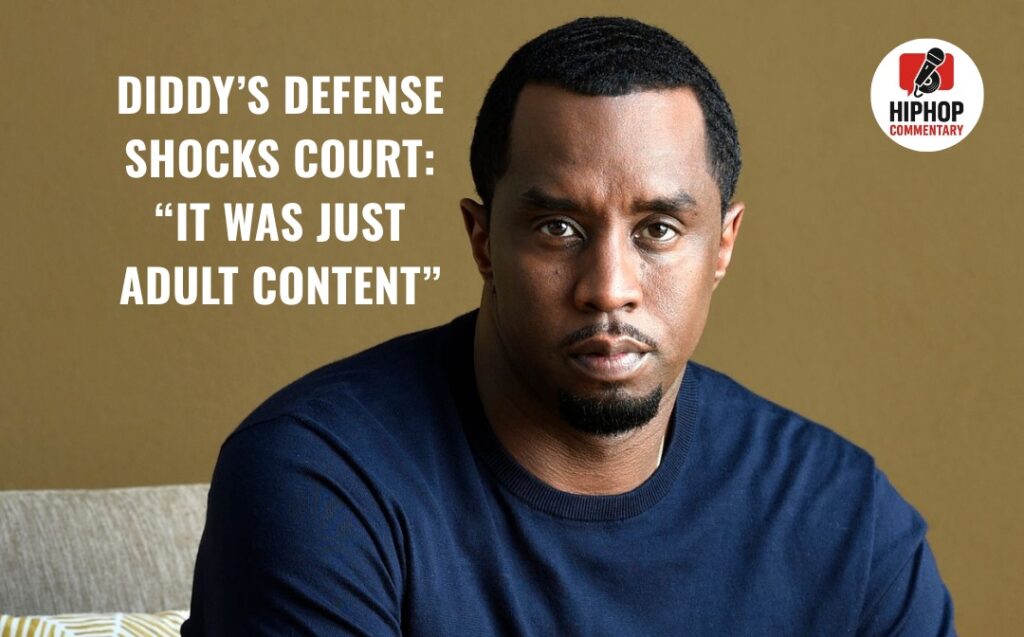
Diddy’s Shocking Court Argument: “Freak-Offs” Were Just Adult Content, Not a Crime
The courtroom is heating up again, and this time Diddy’s legal team is trying to flip the whole story on its head.
What looked like a closed chapter is suddenly back in the spotlight. Sean “Diddy” Combs is serving a 50-month federal sentence, but his lawyers are now pushing a new argument that could shake everything up.
And it’s not small talk. It’s a straight-up challenge to how the case was even understood in the first place.
At the center of it all is something prosecutors called “freak-offs.” That term has been all over the headlines for months. But Diddy’s team is saying people got it wrong from the start.
They’re arguing that what happened wasn’t illegal activity. According to them, it was adult content. Private. Staged. Recorded. Controlled. And never meant to cross into criminal territory.
That one claim changes the angle completely.
Because now the defense is not just fighting the sentence. They’re fighting the meaning of the entire case.
They’re basically saying, this wasn’t a crime scene, it was a production.
But prosecutors are not having it. Not even a little.
They say this wasn’t entertainment or creative work. They say it was organized activity that crossed federal lines, including transporting individuals across states for prostitution-related conduct.
In their view, calling it “content” is just a way to soften something serious. And they’re telling the court not to fall for it.
So now the court is stuck in the middle of two completely different worlds. One side is saying expression and private adult content. The other is saying criminal operation.
And the gap between those two stories is huge.
This appeal is not just about labels though. Diddy’s lawyers are also going after the sentence itself.
They argue the judge made things worse by considering accusations tied to charges Diddy was already cleared of. In their view, that unfairly influenced how long the sentence ended up being.
If the court agrees with that, even partially, it could mean a reduced sentence or at least a new review of how the punishment was decided.
But nothing is decided yet. Right now, it’s all still in motion.
What makes this case so heavy is how different the narratives are depending on who’s talking.
Some people involved describe controlled, private situations between consenting adults. Others describe something far more organized and legally questionable.
And that contradiction is exactly why this appeal is getting so much attention.
Because whichever way the court leans, it could set a tone for how similar cases are handled going forward.
There’s also the bigger picture that people are starting to talk about. Where does adult content end and criminal conduct begin?
That line is not as clear as it used to be, especially in a world where private content, paid content, and recorded content all overlap in messy ways.
And this case is now sitting right in the middle of that debate.
For Diddy, the stakes couldn’t be higher. He’s already serving time. His reputation has taken serious hits. And now he’s trying to convince the system that the foundation of the conviction itself needs to be reexamined.
It’s a tough climb.
Meanwhile, the public reaction is split right down the middle. Some people think the legal team is reaching, trying to reframe serious accusations in a softer light. Others think the justice system might have gone too far in how it interpreted everything.
Either way, nobody is ignoring it.
Because when a case like this reaches this level, it stops being just about one person. It becomes about how the law defines behavior, intent, and consent in situations that are not always easy to label.
And that’s where things get messy.
Right now, Diddy is still behind bars. The appeal is active. The arguments are on the table. And the judges will have to decide whether this was properly handled or if something went off track during sentencing.
Until then, everything stays in limbo.
No final answer. No closure. Just a high-profile case sitting in the balance, waiting for a ruling that could shift how similar cases are viewed in the future.
Because at its core, this isn’t just about fame or headlines.
It’s about where the law draws the line, and whether that line was crossed or misunderstood from the start.