How Suge Knight Used Vanilla Ice to Build Death Row Records
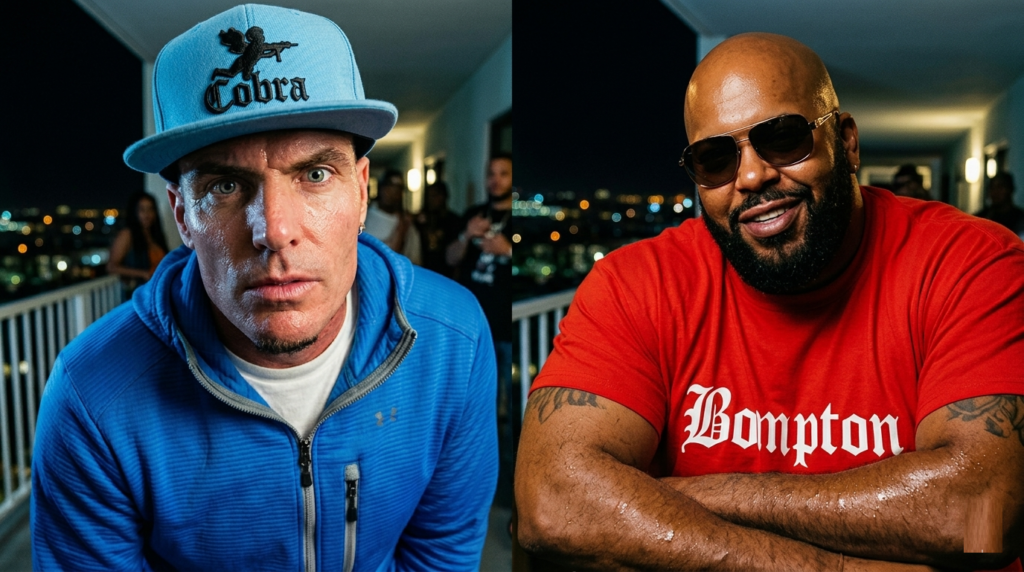
If you’ve been around hip-hop long enough, you already know some names don’t just sit in history, they sit on it. Suge Knight is one of those names. Say it in the wrong room back in the 90s and the energy would shift fast. This was a man who didn’t just run a label. He moved like he ran the whole lane.
Death Row Records wasn’t just music. It was power, fear, money, and dominance all mixed together. Suge built it into a machine that changed rap forever. But the part nobody really forgets is how it started. Not with a rich investor, not with industry backing, but with a pop-rap hit from a kid most hip-hop purists used to laugh at. Vanilla Ice.
Yeah, that Vanilla Ice.
To really get this story, you gotta rewind to 1990. Robert Van Winkle, his real name, was everywhere. “Ice Ice Baby” was blasting out of radios, clubs, and living rooms across America. It was the first rap song to hit number one on the Billboard charts and it stayed there for months. For a moment, he wasn’t just popular. He was everywhere. Like you couldn’t escape him even if you tried.
But hip-hop is a different kind of world. Fame doesn’t automatically mean respect. And respect is everything.
While suburban kids were spinning his tapes, a lot of people inside hip-hop weren’t impressed. To them, Vanilla Ice looked like a visitor trying on someone else’s culture. The outfit fit the chart numbers, but not the streets. That tension followed him everywhere.
And that’s where Suge Knight enters the picture.
Suge didn’t see a joke. He saw opportunity. Where others saw a flashy pop rapper, he saw a stack of money moving with no real protection behind it. In the music industry, especially back then, if you didn’t have muscle or leverage, somebody else would eventually take control of your business for you.
There was also a publishing dispute floating around involving a rapper named Mario “Chocolate” Johnson, who claimed he helped write parts of Vanilla Ice’s biggest hits. Whether every detail of that was fully settled or not, Suge stepped into the situation like someone who already knew how the ending would go.
The story that came out of it is one of those hip-hop legends that gets passed around forever. The “balcony incident.”
Vanilla Ice was staying at the Bel Age Hotel in Los Angeles. According to him, Suge and his people showed up in his suite uninvited. Not a knock-and-wait situation. More like a “we’re already inside” situation. Ice has described walking into a room where Suge was sitting there calm, surrounded by a group that made it very clear this wasn’t a casual conversation.
Ice has said he saw guns. He’s said he understood immediately that this wasn’t a negotiation he controlled.
From there, the details depend on who’s telling it, but the core of the story never really changes.
Suge took him toward a balcony.
Some versions say Ice was held over the edge of a high-rise. Other versions, including Ice’s own later interviews, soften that part and say he was forced to look over the edge while being spoken to in a very controlled, very serious way. Either way, the message landed the same.
Sign over the rights, or risk what happens next.
And under that kind of pressure, Ice signed away millions in royalties right there.
That moment didn’t just change his career. It changed where the money in hip-hop started flowing next.
Suge Knight took those “Ice Ice Baby” earnings and used them to launch Death Row Records in 1991. From there, he linked up with Dr. Dre, who had just stepped away from N.W.A., and built something the industry had never seen before.
Death Row wasn’t just a label. It felt like a movement with its own gravity.
And the irony still hits hard when you look back.
The same money tied to a pop-rap track that hardcore fans used to clown helped fuel some of the most important albums in hip-hop history. Dr. Dre’s The Chronic. Snoop Dogg’s Doggystyle. Later, Tupac’s All Eyez on Me under the Death Row machine. These weren’t just hits. They defined an entire era of West Coast rap.
It’s wild to think about. A label known for its raw, aggressive sound partly started with a song that many people at the time didn’t take seriously. Like building a heavyweight boxing gym off the profits of a dance record. That contradiction is what makes the story stick in your head.
But there was another side to it.
Suge’s way of moving sent a message across the industry. Death Row didn’t operate like a normal label. It had hit records, but it also had a reputation that made people pay attention in a different way. Deals weren’t always just paperwork and handshakes. There was pressure in the air. And once that reputation spread, everybody in the industry understood the tone had shifted.
For Vanilla Ice, the fallout was brutal. Once that story became public, the image never recovered. People already questioned his place in hip-hop. After that night, the conversation wasn’t even about music anymore. It became about credibility. Street respect vanished almost instantly, and with it went his mainstream momentum.
From global superstar to punchline in a very short window. That’s how fast things can flip in this culture.
Looking back now, Death Row’s rise and fall reads like a full tragedy arc. The label burned bright, changed music forever, and then collapsed under lawsuits, violence, and prison sentences. Suge Knight himself ended up serving a long sentence behind bars.
But even with all that, the impact didn’t disappear. You can still hear it in the sound of hip-hop today. The production style, the attitude, the business lessons, all of it traces back to that era.
And the wildest part of this whole story is still the beginning.
One night in a hotel room, a pop star, a future mogul, and a stack of royalty checks collided in a way that reshaped hip-hop history. No boardroom. No press release. Just power, pressure, and decisions made in real time.
It’s one of those stories that reminds you how unpredictable this game really is. In hip-hop, the biggest moves don’t always happen on stage or in front of cameras. Sometimes they happen in quiet rooms, behind closed doors, or on a balcony where everything changes in a single conversation.