The 22-Year Siege: How the Eminem and Benzino War Redefined Rap History
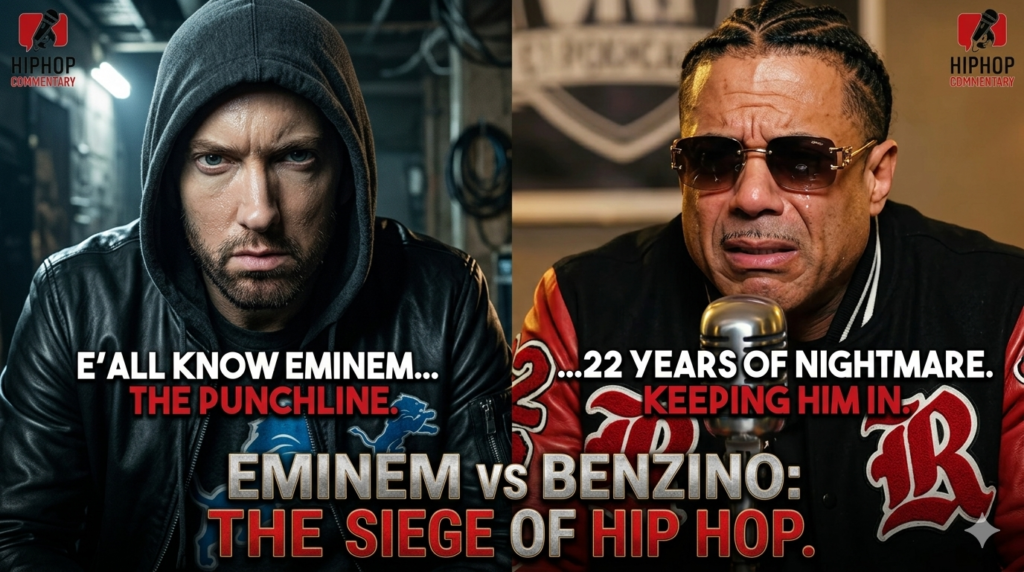
If you’ve been around hip hop long enough, you already know beef ain’t just entertainment. Sometimes it’s fun, like two rappers trading jabs for promo. Other times, it gets real ugly, real personal, and nobody really wins. It just turns into years of tension, interviews, diss records, and pride getting in the way of peace.
And then there’s Eminem and Benzino.
Now this ain’t your regular rap disagreement. This is one of those long, slow-burning wars that stretched across decades. It didn’t just stay on wax either. It bled into media, business, reputation, and even broke down one of the most powerful hip hop magazines in history. Yeah, it went that far.
To really understand how deep this thing runs, you gotta go back to the early 2000s. That was Eminem at his peak. Stadiums packed. Albums going diamond. Movies in theaters. The whole world knew his name. Whether you liked him or not, you couldn’t ignore him.
Then you had Benzino.
Benzino was a rapper too, but his real power wasn’t just music. He was tied up in The Source magazine, which back then was basically the hip hop Bible. If The Source gave you five mics, you weren’t just hot, you were certified. If they didn’t respect you, it mattered. A lot.
They shaped careers. They shaped conversations. They shaped who the culture took seriously.
But things started to get messy when Benzino began using that platform in a very personal way. Instead of staying neutral, he started going at Eminem hard. Calling him a culture vulture. Saying he only blew up because he was white. It wasn’t subtle either. It felt like it had a personal edge to it.
Then came the receipts.
Benzino and The Source dug up old recordings of Eminem from his early battle rap days. Things he said when he was young, angry, and still finding his voice. Some of it was offensive, no question. And Benzino tried to use that as the knockout punch. Like, this is it. This will end him.
But the culture didn’t react the way he expected.
Instead of canceling Eminem, people started looking at Benzino sideways. Because now it didn’t just look like journalism. It looked personal. It looked like a magazine owner using his own platform to attack a rapper who was bigger than him. That’s where everything shifted.
Eminem didn’t sit quiet either.
He came back swinging with tracks like “The Sauce” and “Nail in the Coffin.” And if you know Eminem, you know when he locks in on somebody, it gets surgical. No filler. No wasted bars. Just straight dismantling.
He didn’t just respond, he broke things down piece by piece. Questioned credibility. Questioned motives. Questioned everything.
And the effect wasn’t small.
Over time, The Source lost trust. Advertisers started pulling back. Artists didn’t want to be associated with it the same way. The magazine that once controlled hip hop conversations started slipping. Fast.
Benzino didn’t just lose a rap battle. He lost influence. He lost credibility. And eventually, he lost his grip on the platform that gave him power in the first place.
Now here’s the part that makes this story linger for so long.
Most people would’ve moved on after that. Took the L, rebuilt, shifted focus. That’s what usually happens in this industry. But Benzino never really let it go. Even years later, you’d hear interviews, podcasts, random posts, all circling back to Eminem.
Like the chapter never closed.
At one point, it even got emotional. He went on a podcast and broke down talking about how things played out. You could see the frustration sitting there. Not just anger, but regret mixed with pride that wouldn’t let go. And that’s the dangerous part of long beefs like this. They don’t stay music anymore. They turn into identity.
Eminem, on the other side, mostly moved like he always does. Quiet until he decides not to be.
But every now and then, he reminds people he’s still watching. On “Doomsday Pt. 2,” he went back at Benzino again, mocking him, poking at the same old wounds. And when Eminem does it, it doesn’t feel random. It feels like he still remembers everything.
That’s the thing with him. Even when he’s calm, the battle rapper is still in there.
What makes this whole situation even more interesting is how the perception has changed over time. If you ask younger fans today, Benzino is mostly known from reality TV and old interviews. Not as a major power player in hip hop media, but as the guy who went at Eminem and never really recovered from it.
That shift says everything.
Because at one point, Benzino had real influence. He wasn’t nobody in the culture. He had a seat at the table. But the moment he tried to use that seat to settle a personal score, everything started collapsing.
Meanwhile Eminem did the opposite. He didn’t need a magazine. He didn’t need a platform. He just needed the mic. And when he stepped up, the music spoke louder than anything else.
There’s a lesson buried in all of this, even if nobody likes to admit it.
Power in hip hop is fragile. You can’t force respect. You can’t manufacture it through position or titles. You either earn it through the art or you don’t keep it for long.
And ego can ruin everything.
Benzino had influence but let personal pride turn it into a war he couldn’t win. Eminem had skill, timing, and the ability to out-rap almost anyone who stepped in front of him. When those two collided, the result was predictable in hindsight, even if it didn’t look that way at the start.
Now, decades later, the feud is still part of hip hop history. Not because it’s ongoing drama, but because it shows how messy this culture can get when ego, media power, and lyrical skill all crash into each other.
It’s not just about two men anymore. It’s about what happens when you try to weaponize influence against someone who doesn’t need permission to be great.
And in this game, that difference changes everything.