Why Hip Hop Embraced Eminem and Rejected Vanilla Ice
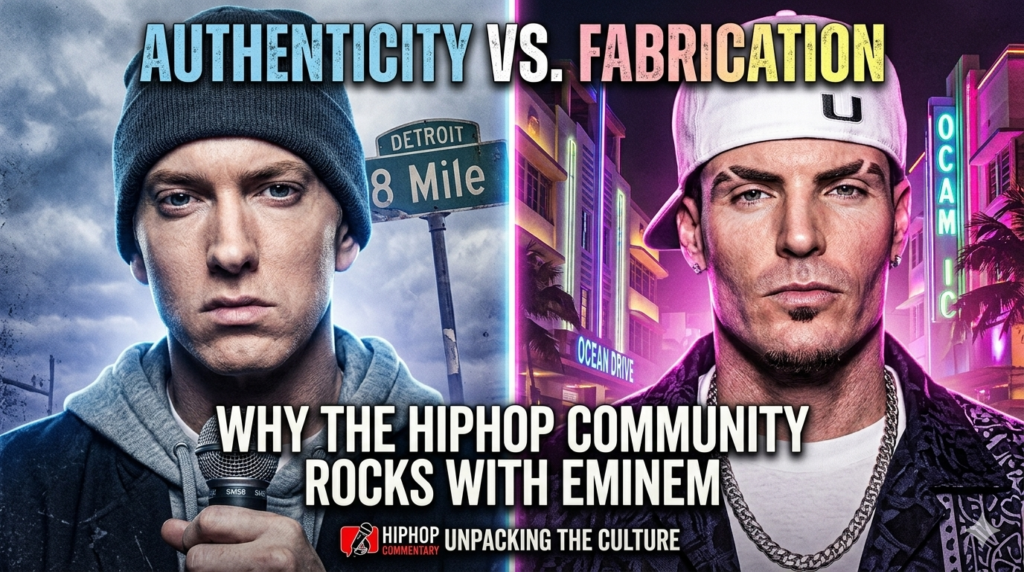
In hip hop, there’s one rule that hits harder than anything else you can say on a track. Be real or get exposed. Simple as that. You can have the flash, the chains, the catchy hook, all of it. But if the story behind it don’t match, the culture will sniff it out quick. No warning. No second chance.
That’s why two of the most famous white rappers in history ended up on totally different paths. Same lane at one point, but worlds apart when it comes to respect. One became a punchline people still laugh about. The other became a name people can’t ignore when they talk about the greatest to ever touch a mic.
It starts with Vanilla Ice.
Back in 1990, “Ice Ice Baby” was everywhere. You couldn’t turn on a radio, walk into a mall, or catch MTV without hearing it. Robert Van Winkle, that’s his real name, looked like a superstar overnight. High-top fade, flashy outfits, dancing like he owned every stage he stepped on. For a minute, it felt like he cracked the code.
Even people who didn’t care about rap knew the hook. He was the first rapper to hit number one on the Billboard charts. That alone made history. But in New York, where hip hop was born and raised, people were looking at it a little different. Because here, you don’t just hear the music. You check the story behind it.
And something about Vanilla Ice didn’t sit right.
At first, his team tried to sell him as a tough kid from Miami. Street background, hard life, all that. But the deeper people looked, the more it didn’t add up. He grew up in the suburbs. He liked motocross. Nothing wrong with that at all, but in hip hop, pretending you came from pain you never lived is dangerous territory.
Because this culture respects truth more than anything.
Once the story started falling apart, so did the image. People didn’t feel played for long, but they definitely felt something was off. And in this game, that’s enough.
Things got even messier when industry pressure kicked in. There’s that infamous story about Suge Knight confronting him and allegedly forcing business decisions in a way that showed Ice wasn’t built for that level of street politics. Whether every detail is exactly how it’s been told or not, the message was loud. This wasn’t his world.
Then came the awkward moments. Trying to align himself with different rap figures, trying to prove he belonged. But it never landed right. It felt forced. And hip hop can spot forced from a mile away.
Pretty soon, Vanilla Ice went from global superstar to cautionary tale. Not because he made one bad song, but because the foundation wasn’t solid. The image came first, and the truth came second. And in this culture, that order matters.
Fast forward a few years, and everything changes again.
A skinny kid from Detroit shows up. Marshall Mathers.
No fancy image. No Hollywood styling. No fake street story. Just a white kid from a trailer park on 8 Mile Road trying to rap his way into something better. And right away, people didn’t know what to think.
Because after Vanilla Ice, nobody trusted the next white rapper walking in the door.
But Eminem didn’t walk in pretending to be anything else. He didn’t try to dress it up. He leaned into everything people could’ve used against him. Broke. Angry. Messy home life. No father around. A complicated relationship with his mom. He put all of it in the music before anyone else could twist it.
That’s the difference right there.
Vanilla Ice tried to build a character. Eminem just told the truth and let it cut how it cut.
There’s something powerful about being first to your own story. If you say it out loud before anybody else can weaponize it, it loses power against you. Eminem figured that out early. He made his pain part of the art, not something to hide behind.
But honesty alone doesn’t get you respect in hip hop. You still gotta rap.
And that’s where Eminem separated himself completely.
Before the fame exploded, he was battling in small rooms, underground spots, places like Scribble Jam. These weren’t friendly crowds. People showed up ready to hate him just because of how he looked. And he still went in there and out-rapped everybody.
Fast flow, sharp punchlines, twisted humor, and that wild energy that felt like he had nothing to lose. That’s when people started realizing this wasn’t a gimmick. This was skill. Real skill.
At that point, race stopped being the main topic. Talent took over.
He wasn’t trying to be accepted. He was forcing people to respect him.
And that’s why Eminem’s story held up over time. He didn’t need to act like someone else to fit in. He built his lane by being louder, sharper, and more technically dangerous than almost anybody in the room.
Even the way he handled criticism was different. Instead of running from it, he would joke about it first. Diss himself before anyone else could. Turn every weakness into a punchline. That kind of control over your own narrative is rare.
Vanilla Ice was built on image. Eminem was built on honesty and skill.
And hip hop always leans toward whoever feels real.
That’s why their legacies look so different today. Vanilla Ice is mostly remembered as a moment in time, a pop crossover story that didn’t last. A name people bring up when they talk about what not to do.
Eminem, on the other hand, became part of the foundation. Grammys, records, influence, respect from rappers across generations. Not because he tried to fit in, but because he refused to fake it.
At the end of the day, hip hop isn’t just about who sells the most records or who has the biggest hit. It’s about whether people believe you. Whether your story feels lived in. Whether your voice sounds like something real came out of it.
Vanilla Ice tried to perform a life.
Eminem lived his and put it on wax.
And in this culture, that difference changes everything.