The Day Loyalty Blocked the Airwaves: DJ Khaled Tony Yayo and the G Unit Terror Squad Rap War
Back in the mid-2000s, New York wasn’t just loud, it felt like it was on edge every single day. You could hear it in the music, see it on the faces in the street, feel it blasting out of Hot 97 in the taxi cabs. Hip hop wasn’t just entertainment at that point. It was tension. It was territory. It was pride.
Right in the middle of all that chaos stood 50 Cent.
After “Get Rich or Die Tryin’” hit the world, 50 didn’t move like a regular rapper anymore. He moved like a general who just won his first war and was ready for the next one. G-Unit wasn’t just a rap crew. It felt like a squad with rules, loyalty tests, and clear lines drawn in the sand. Either you were with them, or you were on the other side. No gray area. No neutral zone.
At first, most of that energy was aimed straight at Ja Rule and Murder Inc. But once that fire started burning, it spread fast. Suddenly, the whole industry felt like it had to pick a side. You weren’t just listening to music anymore. You were being placed in a camp whether you liked it or not.
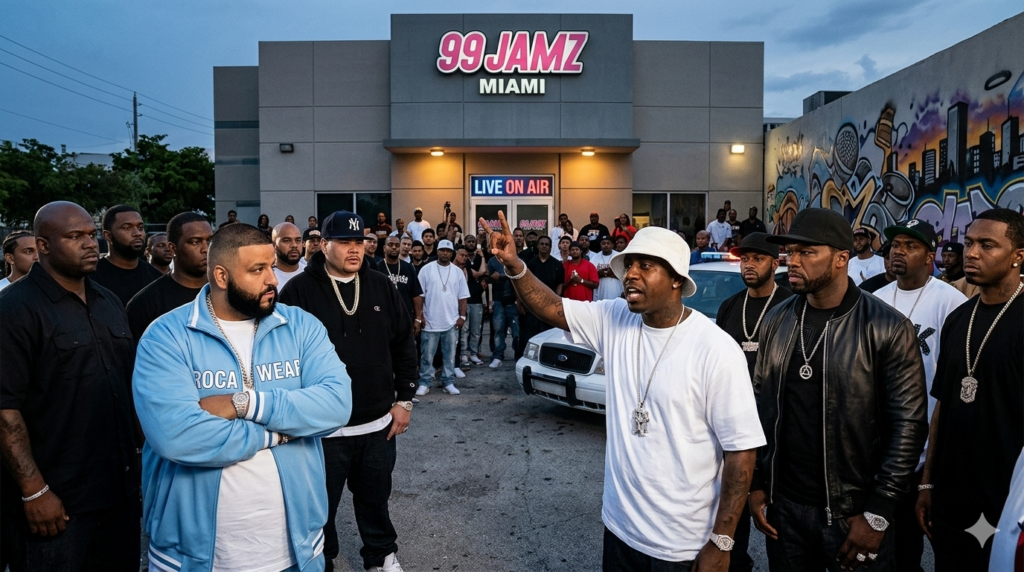
And somewhere in the middle of that storm, a moment happened that had nothing to do with a diss track, a concert, or a street corner argument. It happened inside a radio station in Miami, and it still gets talked about like a ghost story in hip hop circles.
It involved DJ Khaled, Tony Yayo, and a handshake that never made it across the finish line.
To really get why things got tense, you gotta rewind to 2004. Ja Rule dropped a track called “New York,” featuring Fat Joe and Jadakiss. On paper, it sounded like a big city anthem. Heavy names, strong energy, radio-ready hook. But in 50 Cent’s world, that record wasn’t just music. It was a statement. And in his eyes, it was the wrong one.
Because when G-Unit was in full war mode, anything tied to Ja Rule felt like opposition. That’s how the rules worked. So 50 fired back with “Piggy Bank,” and that’s where things got ugly. He didn’t just aim at Ja Rule. He started taking shots at Fat Joe, Jadakiss, and anybody standing anywhere near that record. Suddenly, it wasn’t a one-on-one beef anymore. It felt like the whole industry was getting pulled into it.
If you were even loosely connected to Fat Joe or Terror Squad, you were seen as part of the other side. And in that kind of environment, loyalty mattered more than logic.
Now fast forward to 2005.
Tony Yayo was coming home from prison, and the streets were watching him closely. G-Unit was still at its peak power, and Yayo had real momentum behind him. His album “Thoughts of a Predicate Felon” was on the way, and “So Seductive” was already shaking up clubs. But back then, clubs alone didn’t break records. Radio was still king.
And in Miami, the king of the radio scene was DJ Khaled.
Before the fame, before the shouting ad-libs, before “We The Best,” Khaled was just a powerful DJ at 99 Jamz with deep ties to Fat Joe and Terror Squad. That connection mattered. In hip hop politics, relationships are everything, and Khaled was solid with his people.
So when Yayo’s camp planned a promo run in Miami, there was already tension in the air before they even landed. Yayo himself later admitted he felt uneasy about the trip. He knew how Miami moved, and more importantly, he knew who Khaled was aligned with.
But the visit still happened.
Walking into a radio station back then wasn’t casual. It was a whole event. Cameras, entourages, energy, pressure. Yayo walked in ready to promote his music, do interviews, and keep it moving. But the moment he saw Khaled, the temperature in the room shifted.
Yayo went for the handshake first. Just a normal sign of respect in the industry. Nothing dramatic. Just business.
But Khaled didn’t take it.
Instead, he stood firm and made it clear, loud and direct, that there was no welcome mat for G-Unit in his space. He even shouted his name, “DJ Khaled,” like he was putting a stamp on the moment. It wasn’t subtle. It wasn’t polite. It was a line being drawn in real time.
For a few seconds, everything froze. No music, no jokes, no radio personality energy. Just silence and tension.
Now think about the context. G-Unit was one of the most powerful forces in hip hop at the time. Refusing a handshake from one of 50 Cent’s main soldiers wasn’t a small move. That took real conviction.
Later on, Yayo admitted something interesting. Even though the moment was uncomfortable, he respected Khaled for it. In his mind, Khaled wasn’t being fake or political. He was standing on loyalty. He wasn’t switching sides just because a major label artist walked into his station. And in an industry full of people trying to play both sides, that kind of stance sticks with you.
For a long time, this story floated around like industry folklore. People argued about what really happened, how it went down, who said what. Until years later, Khaled finally spoke about it openly on “Club Shay Shay.”
He kept it simple. He said radio DJs are supposed to be neutral, but he wasn’t built that way in that moment. Fat Joe had been there for him when he was coming up, and that loyalty meant something real. If he had smiled, shaken hands, and acted like nothing was going on, he wouldn’t have been able to live with that choice.
That’s the part people don’t always talk about in hip hop. The emotional side. The codes people carry even when business says otherwise.
Looking back now, that Miami radio station moment says a lot about that era. Rap wasn’t just about streams or charts. It affected where you could go, who would play your record, and how people treated you in different cities. A handshake wasn’t just a greeting. It was a statement.
For Yayo, it was a reminder that even G-Unit couldn’t override local loyalty. For Khaled, it was one of those early moments that helped shape his reputation as someone who stands ten toes down for his people. That reputation later helped him build the “We The Best” empire.
And for everyone watching, it was proof that hip hop politics weren’t just on records. They were in rooms, in real time, with real consequences.
Today, a lot of those old beefs are settled or softened. 50 Cent and Fat Joe eventually made peace years later, realizing life was bigger than the drama. Time has a way of cooling things down.
But stories like this still matter because they show what hip hop used to be at its core. Not just music, but loyalty, pressure, and pride all colliding in real spaces. And sometimes, the smallest moment, like a handshake that didn’t happen, tells you everything you need to know about the whole game.