When Eminem Turned Anthony Mackie’s Perfect Life Into a Rapper’s Nightmare
Hip hop battles usually follow a simple formula. You find the weakest part of a person and you hit it over and over. You talk about where they came from, what they don’t have, or what they’re pretending to be. It’s almost like a game of pain hunting. Whoever lands the sharpest blow usually walks away with the crown, at least in the eyes of the crowd.
But every once in a while, someone changes the rules without asking permission. That’s exactly what happened during the making of 8 Mile back in 2002, when Eminem flipped a rap battle on its head and turned “having a good life” into something you could actually get clowned for.
At the time, 8 Mile wasn’t just another music movie. It was supposed to show real Detroit energy, the kind of places where battles weren’t cute or polished. It followed B-Rabbit, a quiet kid trying to break through in the underground scene while dealing with a rough home life and constant pressure. It felt real because Eminem wasn’t just acting, he was pulling from his own past.
Everything builds up to one final battle at The Shelter. That scene is the heart of the movie. If you’ve ever been in a real rap battle spot, you know the feeling. Tight room, loud crowd, tension so thick you can almost taste it. In Rabbit’s way stands Papa Doc, the leader of the rival crew called The Free World.
Papa Doc was played by Anthony Mackie, who later became known worldwide for his Marvel roles. Back then, though, he was just a young actor trying to make his mark. He had the look of a guy you don’t want to step to. Calm face, solid build, quiet confidence. Perfect casting for someone meant to look like a serious threat.
Originally, the battle scene was written like most movie rap battles. A few insults back and forth, a build-up, and then the hero wins. Simple. But Eminem wasn’t satisfied with that. It felt too clean, too scripted. Real battles don’t move like that. Real battles feel unpredictable, messy, and sometimes even uncomfortable.
So he started changing things.
What Eminem realized was simple but powerful. In most rap battles, people try to hide their flaws. They avoid their weak spots and pray the opponent doesn’t find them. So instead of playing defense, he flipped it. He made B-Rabbit attack himself first.
In the scene, Rabbit basically exposes his whole life before Papa Doc even gets a chance to speak. He talks about being broke. He talks about living in a trailer. He talks about his messy situation with his mom. All the things an opponent would normally try to use against him, he says out loud first.
That move changed everything. Once the crowd laughs with you at your own struggles, nobody else can use them against you. It’s like taking the bullets out of someone’s gun before they even raise it.
Then comes the real twist.
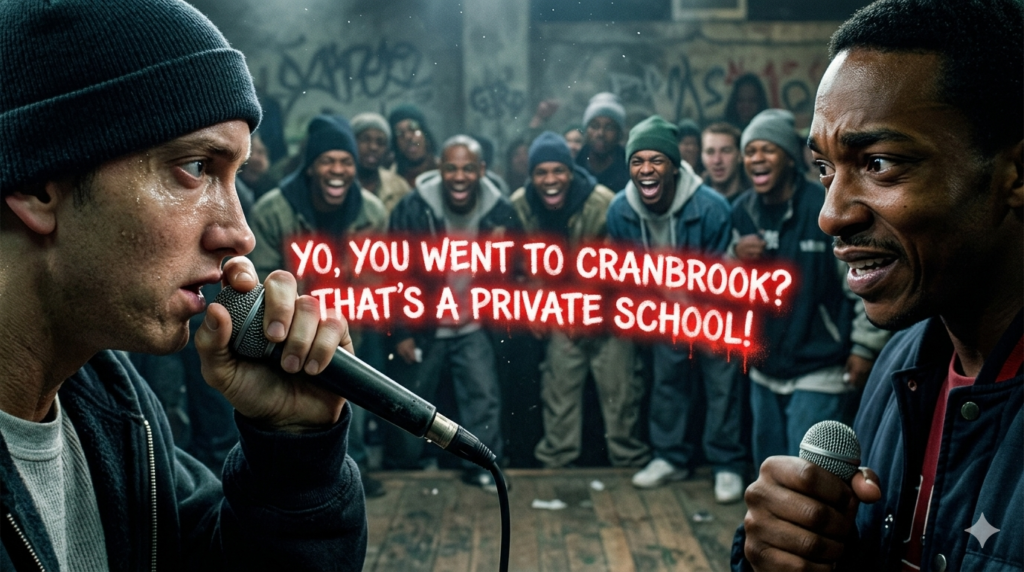
Papa Doc, the “toughest” guy in the room, gets hit with something he wasn’t ready for. Instead of being called a criminal or a street legend, he gets exposed as something nobody expected in that setting, a kid from a privileged background. Eminem’s character reveals that Papa Doc went to Cranbrook, a well-known private school in Michigan. Expensive. Polished. Safe.
And just like that, the image falls apart.
In the world of that battle, image is everything. Papa Doc was supposed to represent danger and street credibility. But once that Cranbrook line drops, the whole room sees him differently. Not as a threat, but as someone playing a role he never really lived.
That’s the moment everything breaks. The crowd reacts instantly. Laughter takes over. Energy shifts. Papa Doc doesn’t even get the chance to respond because the battle is already decided in everyone’s head.
What makes this scene so legendary isn’t just the insult itself, but the strategy behind it. Eminem didn’t attack harder. He attacked smarter. He understood something most people miss in rap battles. If you control the narrative before your opponent speaks, they’re already behind.
Anthony Mackie has talked about filming that scene in interviews. Even though it was acting, he said Eminem’s delivery was so sharp and fast that it caught him off guard at first. But instead of frustration, there was respect. You could tell it wasn’t just lines being read. It felt like real improvisation happening in front of a live crowd.
And honestly, that’s why the scene still holds up today. It doesn’t feel scripted. It feels like a real moment where somebody got completely outplayed in real time.
Over the years, that battle has become one of the most replayed hip hop movie scenes ever. Not because of flashy effects or big production, but because of the idea behind it. Eminem showed that vulnerability can be a weapon. If you own your truth before anyone else can twist it, you take away their power.
He also proved something else that sticks in hip hop culture. Being real doesn’t always mean hiding your flaws. Sometimes it means exposing them so fully that nobody can use them against you again.
That Cranbrook line still gets referenced today. People bring it up whenever someone is trying too hard to act tough or fake an image they didn’t really live. That’s the mark of a perfect diss. It doesn’t fade. It becomes part of the culture’s memory.
Looking back, that moment in 8 Mile wasn’t just a movie scene. It was a lesson in strategy, confidence, and control. Eminem didn’t just write a battle. He redefined how one could be won.
And in a culture built on competition, that kind of move doesn’t get forgotten.